Derivative Strategy Categories and Risk Matching
Identify common derivative strategy categories, compare their high-level risk profiles, and match a market view and client constraint to an appropriate strategy type.
This section explains how derivative strategies are grouped and how those categories should be matched to a market view and a constraint. CIRE does not require exhaustive payoff-diagram mastery for every strategy. It does require students to recognize whether a strategy is broadly bullish, bearish, neutral, income-oriented, spread-based, or volatility-oriented, and to identify the primary risk that comes with that structure.
The strongest answer does not choose a strategy because the name sounds familiar. It starts with the market view, then asks what the client or trader is trying to achieve, what losses are tolerable, and whether the risk is defined or potentially open-ended.
Strategy Categories Are a Decision Shortcut
Strategy categories are useful because they organize a large derivative universe into a smaller number of economic ideas. At a high level, the main categories are:
- bullish strategies
- bearish strategies
- neutral strategies
- income-producing strategies
- spread strategies
- volatility strategies
These categories are not mutually exclusive in every technical sense. A strategy can sometimes reflect more than one feature. But for CIRE purposes, the category helps students identify what the position is mainly trying to express.
Bullish and Bearish Strategies Express Directional Views
Bullish Strategies
A bullish strategy is designed for a view that the underlying will rise or that upward exposure is desirable. The key issue is whether the strategy creates:
- defined downside
- leverage
- limited upside or unlimited upside
- an obligation as well as an opportunity
The strongest answer does not stop at “bullish equals positive view.” It asks how the bullish view is being expressed and what the primary risk is if the market does not cooperate.
Bearish Strategies
A bearish strategy is designed for a view that the underlying will fall or that downside exposure is desirable. Again, the exam point is not only market direction. It is also whether the strategy uses:
- a purchased right
- a written obligation
- a multi-leg structure that limits both gain and loss
Students should understand that a bearish strategy can still be very risky if it creates open-ended or poorly controlled exposure.
Neutral, Income-Producing, and Spread Strategies Serve Different Purposes
Neutral Strategies
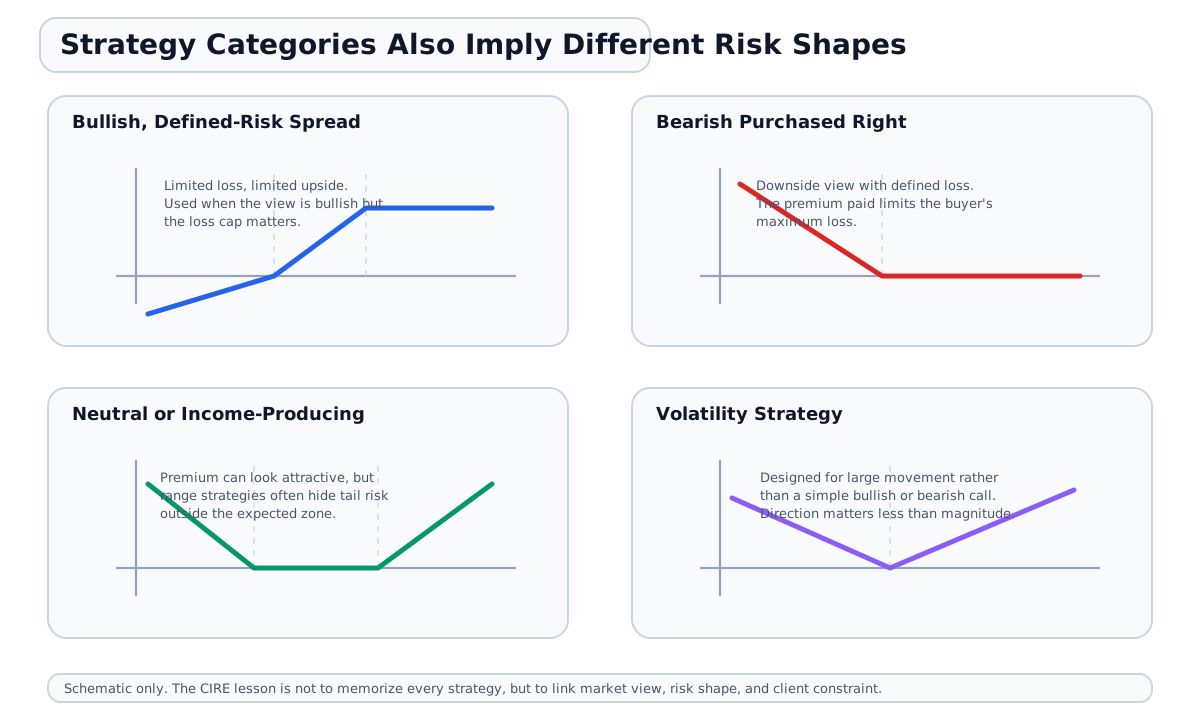
Neutral strategies are typically used when the view is that the underlying will remain in a range, or when the investor wants to benefit from stability rather than a sharp directional move. The exam often tests this by giving a client with no strong directional view and asking which category fits best.
Income-Producing Strategies
Income-producing strategies are often described as generating premium or income-like cash flow. Students should be cautious here. A strategy that produces upfront premium can still involve meaningful contingent risk. “Income” does not mean “safe.”
Spread Strategies
Spread strategies combine positions to shape risk and reward more precisely. At a high level, spreads often:
- define or limit risk
- cap upside and downside compared with a more open-ended alternative
- express a view with more structure than a simple single-leg position
This makes spreads especially important in exam questions involving clients or accounts with a directional view but some desire for controlled risk.
Volatility Strategies Focus on Movement Rather Than Simple Direction
A volatility-oriented strategy is designed to benefit from significant movement, unusually low movement, or changes in uncertainty rather than from a simple bullish or bearish opinion alone.
This matters because students often try to force every derivative strategy into a direction-only framework. Some positions are really about the expected size or pattern of movement, not about a simple prediction that price will rise or fall.
Defined Risk and Open Risk Should Be Distinguished Early
One of the most important Chapter 8 distinctions is whether the strategy has defined risk or a more open-ended risk profile.
At a high level:
- a defined-risk strategy places a clearer limit on the likely downside under the strategy’s structure
- an open-risk or less bounded strategy can expose the account to losses that are harder to cap
Students should not assume that a multi-leg strategy is automatically safer, but they should recognize that structure matters. A strategy that uses combinations to shape exposure may be more defensible for a client with limited loss tolerance than a strategy with more open-ended obligations.
    flowchart TD
	    A[Market view and client constraint] --> B{Primary view}
	    B -->|Bullish| C[Bullish strategy category]
	    B -->|Bearish| D[Bearish strategy category]
	    B -->|Range-bound or stable| E[Neutral or income category]
	    B -->|Large movement expected| F[Volatility category]
	    C --> G{Risk preference}
	    D --> G
	    E --> G
	    F --> G
	    G -->|Defined risk preferred| H[Spread or limited-risk structure]
	    G -->|Open risk acceptable only if approved and controlled| I[More open-ended structure]
The diagram matters because strategy selection should start with the view and then move immediately to the risk constraint. Students often reverse that order and choose a named strategy without clarifying what problem it is supposed to solve.
The SVG below adds the missing payoff intuition. It is not meant to teach every strategy in detail. It shows why different categories imply different risk shapes even when two strategies might sound equally attractive in a conversation.
Matching Strategy to View Requires More Than Label Recognition
The curriculum expects students to apply strategy-category selection at a high level. A useful process is:
- Identify the market view.
- Identify whether the client needs exposure, protection, income, or controlled speculation.
- Ask whether the client can tolerate open-ended risk.
- Select the category that best matches both the view and the risk constraint.
- State the primary risk clearly.
For example:
- a bullish view with limited-loss tolerance may point toward a defined-risk bullish category rather than a more open-ended obligation-based position
- a neutral view may point toward a range-based or premium-oriented category, but only if the contingent risk is understood and acceptable
- an expectation of large movement may point toward a volatility-oriented category rather than a pure directional category
The Primary Risk Should Always Be Named
In strategy questions, students often identify the general category correctly but fail to identify the main risk. That weakens the answer because strategy selection is inseparable from risk analysis.
Common high-level risks include:
- loss if the market moves opposite to the view
- open-ended or amplified loss if obligations are created
- limited gain despite taking meaningful risk
- loss from time decay or from lack of expected movement
The strongest answer states both the strategy category and the main risk in plain language.
Income Language Can Hide Risk
One common exam trap is the label “income-producing.” Students may assume that a premium-generating strategy is conservative because it produces cash flow at the outset. But the correct response is to ask:
- what risk was accepted in exchange for that premium?
- is the risk defined or open-ended?
- what happens if the market moves sharply?
This is often the difference between a superficial answer and a strong one.
Strategy Selection Should Stay High-Level and Defensible
CIRE is not trying to turn the student into a professional derivatives strategist. The exam emphasis is on disciplined classification:
- What is the market view?
- What is the strategy category?
- What is the primary risk?
- Does the structure fit the client’s constraints?
This approach prevents overcomplication and keeps the analysis aligned with account suitability and control logic.
Common Pitfalls
- Choosing a strategy category by name familiarity rather than by market view.
- Ignoring whether risk is defined or more open-ended.
- Treating premium-generating strategies as automatically conservative.
- Forcing a volatility-based view into a simple bullish or bearish category.
- Failing to identify the primary risk after naming the strategy.
Key Terms
- Bullish strategy: A strategy designed to benefit from rising prices or upside exposure.
- Bearish strategy: A strategy designed to benefit from falling prices or downside exposure.
- Spread strategy: A combination structure used to shape risk and reward more precisely.
- Volatility strategy: A strategy focused on the degree or pattern of movement rather than only direction.
- Defined risk: A structure in which downside exposure is more clearly limited by the strategy design.
Key Takeaways
- Derivative strategies are easiest to analyze by category rather than by isolated product names.
- Market view and client constraint should be identified before selecting a strategy category.
- Bullish, bearish, neutral, income, spread, and volatility categories serve different purposes.
- Defined risk and open-ended risk should be distinguished early.
- A strong answer identifies both the strategy category and the primary risk.
Quiz
Sample Exam Question
A client has a moderately bullish market view but says she is not willing to accept an open-ended loss profile. The representative recommends a strategy that produces significant premium income up front and says that the premium received proves the strategy is conservative. The representative does not compare the recommendation with a defined-risk alternative and does not explain the strategy’s primary risk if the market moves sharply against the position.
What is the strongest assessment?
- A. The recommendation is strong because any premium-generating strategy is conservative by definition.
- B. The recommendation is strong because a bullish client should always use the strategy with the highest initial income.
- C. The recommendation is weak because strategy selection should match both the market view and the client’s loss constraint, and premium generation does not eliminate the need to assess open-ended risk.
- D. The recommendation is acceptable because primary risk analysis matters only for multi-leg spreads.
Correct answer: C.
Explanation: The representative focused on the attractiveness of upfront premium without addressing the client’s stated limit on acceptable downside. Chapter 8 strategy questions require students to match the strategy not only to the market view but also to the risk constraint. A premium-generating structure may still create substantial or open-ended risk. Option C recognizes that the missing analysis is the primary weakness. Options A, B, and D all treat strategy labels or premium features as substitutes for genuine risk matching.