Derivative Uses, Premium Drivers, Margin, and Leverage
Review the main uses of derivatives, the basic elements of options and futures transactions, and the high-level factors that affect option premiums, margin, and leverage.
This section explains why derivatives are used and how their value is affected by the main pricing drivers that appear in CIRE questions. Students are not expected to perform advanced derivatives pricing. They are expected to understand the directional logic of hedging, speculation, arbitrage, option premium drivers, and the role of mark-to-market, margin, and leverage.
The strongest answers usually start with purpose. A derivative used for hedging should be assessed differently from one used for speculation, even if the same contract type appears in both cases.
Derivatives Can Be Used for Hedging, Speculation, or Arbitrage
The curriculum identifies three broad uses of derivatives:
- hedging
- speculation
- arbitrage
Hedging
Hedging uses a derivative to reduce or offset an existing risk. A client holding a stock position may use a derivative to reduce downside exposure. A firm with currency or rate exposure may use a derivative to stabilize the economic effect of market movements.
The key idea is protection or risk management. A hedge may reduce upside or involve a cost, but the main purpose is to control exposure rather than to maximize directional gain.
Speculation
Speculation uses a derivative to express a market view or gain economic exposure. Because derivatives often require less capital than direct ownership, they can magnify both gains and losses. That makes speculation a higher-control use case than a simple directional opinion expressed through an ordinary cash security.
Arbitrage
Arbitrage seeks to profit from a pricing difference or mismatch between related exposures or markets. CIRE treats this concept at a high level. Students should understand that arbitrage is not simply “a smart trade.” It depends on identifying inconsistent pricing or relationships across positions.
The exam often tests these uses by asking what the client or trader is trying to accomplish. Once the purpose is identified, the rest of the analysis becomes more coherent.
Transaction Elements Help Explain Derivative Exposure
Students should be comfortable with the basic transactional elements that appear repeatedly in derivative questions.
| Element | High-level meaning | Why it matters |
|---|---|---|
| Underlying interest | The security, index, rate, currency, or other reference driving value | It determines what economic exposure the derivative provides |
| Premium | The price paid for certain derivative rights, especially options | It affects cost and risk to the buyer |
| Strike price | The exercise or reference price in an option contract | It shapes how attractive the option becomes as the market moves |
| Time to expiry | The remaining life of the contract | It affects opportunity, uncertainty, and time-related value |
| Volatility | The degree of expected movement in the underlying | It influences option value because greater movement can make the right more valuable |
| Mark-to-market | Ongoing revaluation of positions based on market movement | It affects daily gains, losses, and collateral requirements |
| Margin | Collateral or financial support required to carry the position | It is part of the firm’s control framework |
| Leverage | Economic exposure greater than the initial cash outlay | It magnifies both gains and losses |
Students should not memorize these as isolated vocabulary. The exam uses them to ask how contract value and account risk change when the market moves.
Underlying Price Changes Affect Calls and Puts Differently
At a high level, option premiums react directionally to movements in the underlying.
- When the underlying price rises, a call option generally becomes more valuable than it was before, all else equal.
- When the underlying price falls, a put option generally becomes more valuable than it was before, all else equal.
The reverse logic also matters:
- if the underlying falls, a call generally loses attractiveness
- if the underlying rises, a put generally loses attractiveness
The exam usually tests this concept directionally rather than mathematically. Students should therefore be ready to explain whether a change makes the option more or less valuable, not to calculate the exact premium.
Volatility Can Increase Option Value Because It Increases Possibility
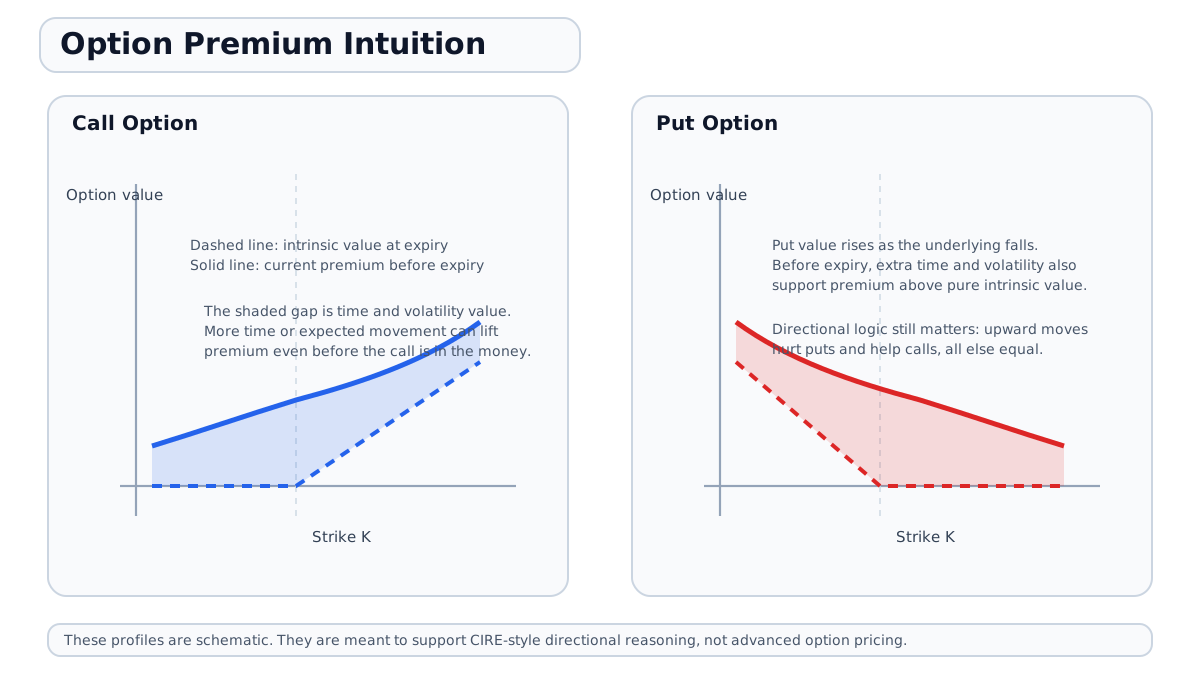
Volatility matters because options derive value from the possibility that the market may move meaningfully before expiry. Greater expected movement can increase the attractiveness of the right embedded in the option.
At a high level:
- more volatility generally supports higher option premiums
- less volatility generally reduces that extra uncertainty-related value
This is a common exam trap because students may focus only on market direction and forget that the size and uncertainty of possible movement also matter.
    flowchart TD
	    A[Option premium] --> B[Underlying price direction]
	    A --> C[Volatility]
	    A --> D[Time to expiry]
	    B --> E[Directional effect on call or put]
	    C --> F[More or less opportunity for value]
	    D --> G[More or less time for the view to play out]
	    E --> H[Premium changes]
	    F --> H
	    G --> H
The diagram matters because option premium is not driven by one variable only. In fact patterns, the best answer often identifies two or three drivers moving at the same time.
The SVG below adds the missing price-axis intuition. It shows why calls and puts respond in opposite directions and why time and volatility can keep premium above pure intrinsic value before expiry.
Time to Expiry Affects Opportunity and Time Value
Time matters because an option with more time remaining usually has more opportunity for the underlying to move in a favorable way. As expiry approaches, that opportunity shrinks.
High-level directional logic:
- more time to expiry generally supports a higher premium than otherwise similar conditions with less time
- as time passes, the value linked to remaining opportunity generally declines
Students do not need advanced option-theory terminology to answer many CIRE questions correctly. They do need to recognize that time itself can change premium, even if the underlying price does not move much.
Mark-to-Market, Margin, and Leverage Are Control Concepts as Well as Economic Concepts
Chapter 8 also expects students to understand why derivatives require a control framework around daily or ongoing valuation, collateral, and exposure.
Mark-to-Market
Mark-to-market means the position is revalued against current market conditions. The point is to reflect actual gains or losses as they emerge rather than leaving the account on an outdated basis.
Margin
Margin is collateral or financial support required because the position can create obligations or losses that exceed the initial cash commitment. Margin is therefore not just a financing feature. It is a risk-control device for the firm and the account.
Leverage
Leverage allows a derivative to create more economic exposure than would be created by the same initial cash outlay in a simple cash purchase. This can make derivatives attractive for tactical use, but it also makes losses accelerate quickly if the market moves unfavorably.
Students should therefore treat leverage as a control issue, not just as an opportunity feature.
A Hedge and a Speculation Should Not Be Analyzed the Same Way
One of the strongest Chapter 8 distinctions is that the same derivative contract can serve different purposes depending on context.
For example:
- an option may be used to protect an existing position
- the same type of option may be used to speculate on a price move without owning the underlying
The client’s objective changes the analysis. A hedging trade should be judged by how well it controls risk. A speculative trade should be judged by the exposure it creates, the leverage involved, and the risk controls supporting it.
Directional Questions Usually Reward Logic, Not Formula Memorization
A useful exam sequence is:
- Identify whether the purpose is hedging, speculation, or arbitrage.
- Identify the derivative’s underlying interest and structure.
- Ask how changes in underlying price affect the contract.
- Ask whether changing volatility or time to expiry makes the option more or less valuable.
- Consider whether mark-to-market, margin, and leverage intensify the account risk.
This approach lets students solve many Chapter 8 questions without advanced quantitative methods.
Common Pitfalls
- Treating all derivative use cases as speculation.
- Ignoring the difference between hedging a risk and taking on a new leveraged view.
- Focusing only on underlying direction and forgetting volatility or time to expiry.
- Treating margin as optional convenience instead of as part of the firm’s control framework.
- Assuming leverage changes only potential profit and not potential loss.
Key Terms
- Hedging: Using a derivative to reduce or offset an existing risk.
- Speculation: Using a derivative to express a market view or seek gain from price movement.
- Arbitrage: Seeking to benefit from a pricing mismatch between related exposures or markets.
- Strike price: The reference price used in an option contract.
- Mark-to-market: Ongoing revaluation of a position to reflect current market conditions.
Key Takeaways
- Derivatives are used for hedging, speculation, and arbitrage, and the objective changes the analysis.
- Premium, strike, expiry, volatility, margin, and leverage are core transaction elements.
- Underlying price changes affect calls and puts differently.
- Greater volatility and more time to expiry generally support greater option value, all else equal.
- Mark-to-market, margin, and leverage are central to both economics and control.
Quiz
Sample Exam Question
A client buys call options on a stock index because she expects a strong market rebound over the next two months. One week later, the index has not moved much, but expected market volatility has increased significantly. The representative tells the client that the options should not be affected because only the index level matters, and also says margin is irrelevant because the client paid a premium up front.
What is the strongest assessment?
- A. The representative is correct because volatility changes matter only for puts, not calls.
- B. The representative is weak on both points because option value can be affected by volatility even if the underlying barely moves, and derivatives control concepts cannot be dismissed simply because a premium was paid.
- C. The representative is correct because premium, volatility, and margin are unrelated concepts.
- D. The representative is correct if the options are European-style rather than American-style.
Correct answer: B.
Explanation: The representative incorrectly reduces option value to underlying price movement alone. Option premiums can also change when expected volatility changes. In addition, the broader derivatives-control framework should not be dismissed casually. Even where a buyer pays a premium, derivatives analysis still involves exposure, valuation, and account-control concepts rather than a simplistic “cash paid means no risk issue” approach. Options A, C, and D all ignore the role of volatility and the broader control logic that Chapter 8 expects students to recognize.