Order Types, Handling Decisions, and Trade Corrections
Review key order types, how to match orders to client objectives, and how cancellations, corrections, settlement conventions, and remediation should be handled.
This section explains how order instructions change execution outcomes and why order handling is a control issue, not just a mechanical step. Chapter 6 expects students to understand the trade-offs built into common order types and to identify the proper response when an order must be varied, cancelled, corrected, or remediated.
The main exam trap is to focus on the order label without linking it to the client’s objective. Strong answers explain why a certain order type fits a client’s need for price control, execution certainty, risk management, or confidentiality.
What This Lesson Is Usually Testing
- Whether the candidate matches the order instruction to the client’s real execution objective.
- Whether the candidate distinguishes price control from execution certainty.
- Whether the candidate treats order changes and trade errors as control issues requiring records and escalation.
- Whether the candidate notices when an entered order does not match the client’s stated instructions.
Common Clue -> Stronger Answer Direction
| If the stem emphasizes | Stronger answer direction |
|---|---|
| “Get it done” or urgency | Move toward execution certainty and market-order logic, then note price risk |
| “Not above” or “not below” a stated price | Move toward limit-order logic and non-execution risk |
| Trigger point, protection level, or conditional instruction | Consider stop-order behavior and market-condition risk |
| Hidden size or limited market visibility | Explain iceberg-style intent and execution discretion |
| Client changed instructions, cancellation, or booking mistake | Shift from order choice to documentation, correction, and remediation controls |
What Stronger Answers Usually Do
- Translate the client’s words into the right execution trade-off.
- Explain why the chosen order type helps and what it gives up.
- Notice immediately when the representative entered the wrong instruction.
- Treat corrections and remediation as documented control processes, not informal cleanup.
Core Order Types and Their Main Trade-Offs
The most important order-type distinction in CIRE is the trade-off between price certainty and execution certainty.
Market Orders
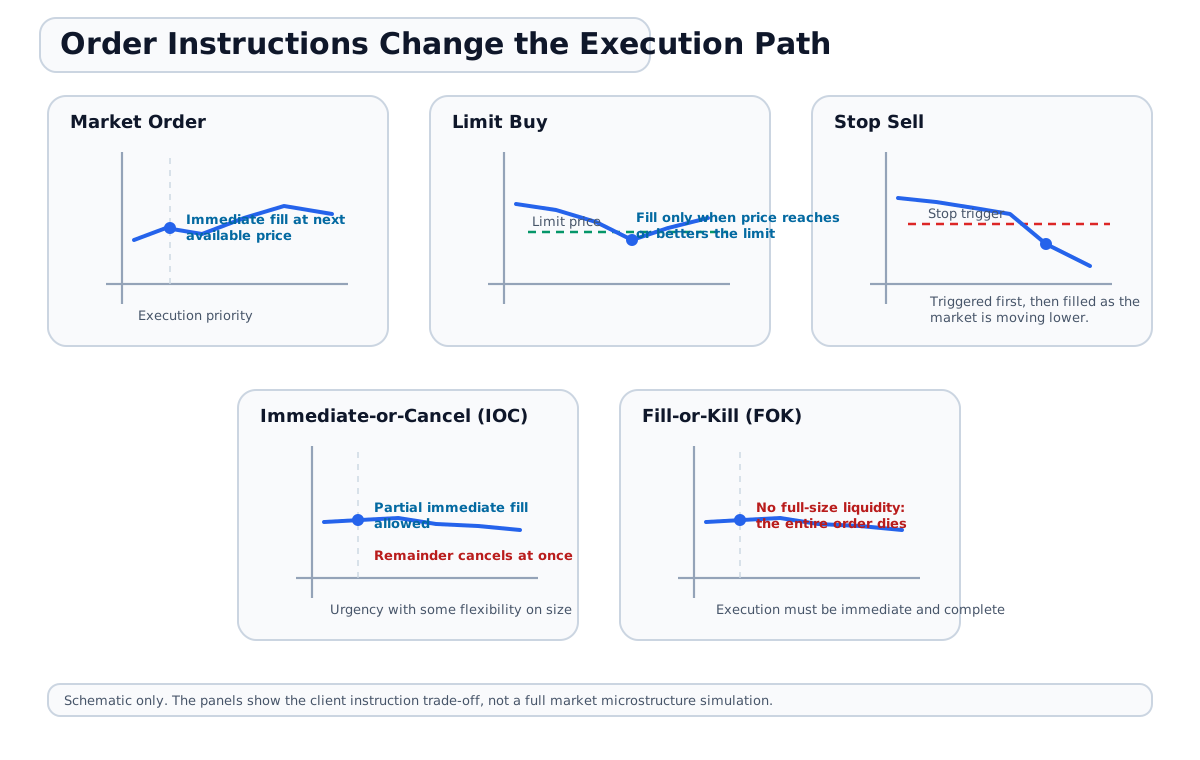
A market order prioritizes execution. The client is saying that immediate participation matters more than controlling the exact price. This can be useful when execution certainty is the main goal, but it also means the final execution price may vary from what the client last observed.
Limit Orders
A limit order prioritizes price control. The client sets the highest acceptable purchase price or lowest acceptable sale price. This protects price discipline, but the trade may not execute if the market never reaches the limit.
Stop Orders
A stop order activates once a specified trigger price is reached. At a high level, stop orders are often associated with conditional execution or risk management, though the exact result can still depend on market conditions when the order is triggered.
Short Sale Orders
A short sale involves selling borrowed securities. That makes short-sale orders different from ordinary long-sale orders because settlement, marking, supervision, and risk considerations are more complex.
Other Important Order Features
Chapter 6 also expects recognition of some additional order features:
- Immediate-or-cancel (IOC): execute immediately to the extent possible, then cancel the rest
- Fill-or-kill (FOK): execute immediately in full or not at all
- Iceberg orders: expose only part of the order size while the full interest remains larger than what is displayed
These features matter because they change the balance between visibility, urgency, and execution strategy. Students do not need to design a trading algorithm, but they should understand why one feature may fit a client’s objective better than another.
Matching the Order to the Objective
| Objective | Order type or feature often most relevant |
|---|---|
| Immediate execution | Market order |
| Price control | Limit order |
| Conditional activation | Stop order |
| Immediate partial execution acceptable | IOC |
| All-or-nothing urgency | FOK |
| Reduced displayed size | Iceberg |
The exam usually rewards reasoning, not memorized labels. The strongest answer explains the trade-off the client appears to prefer.
The SVG below is useful because order handling is not only about labels. It shows how a different instruction can change the trigger point, the fill condition, or whether the order is cancelled immediately.
Order Handling Means More Than Entry
Proper order handling includes the way the order is recorded, reviewed, transmitted, and monitored. If the client changes instructions, cancels an order, or needs a correction, the process must be documented and controlled.
    flowchart TD
	    A[Client instruction] --> B[Order entered and recorded]
	    B --> C{Order change needed?}
	    C -->|No| D[Route and execute]
	    C -->|Yes| E[Document variation or cancellation]
	    D --> F{Execution issue or error?}
	    F -->|No| G[Confirm and settle]
	    F -->|Yes| H[Escalate correction and remediation]
	    E --> D
	    H --> G
The point of this process is evidence and control. Order handling should not depend on memory or informal side conversations when the order changes or a mistake occurs.
Cancellations, Variations, and Corrections Require Clear Documentation
Clients may change price limits, cancel an order, or correct an instruction. Those events matter because they can affect the sequence of execution and the dealer’s ability to defend what happened later.
The strongest high-level response includes:
- recording the client’s revised instructions clearly
- confirming when required that the order status changed
- ensuring the operational team and desk are aligned on the new instruction
- preserving an audit trail that shows the sequence of events
Students should recognize that a correction is not only an operational matter. It also affects transparency and dispute prevention.
Trade Corrections and Remediation
Trade corrections matter because execution errors can cause direct client harm if they are not addressed quickly and transparently. Chapter 6 tests this at a high level: the dealer should escalate, preserve the record, correct the error if possible through the proper workflow, and communicate clearly with the client where required.
Important high-level themes include:
- timely escalation
- accurate reconstruction of what happened
- transparent remediation
- avoiding repeated errors through review of the control failure
The exam often tests whether the firm chose a documented remediation path or tried to solve the issue informally without preserving the record.
Settlement and Delivery Conventions Still Matter
Settlement and delivery conventions should be understood at a high level because the client and the dealer need to know when a trade is expected to complete. The exam does not usually require product-by-product timing memorization, but it does expect recognition that:
- settlement timelines can vary by product
- conventions should be stated clearly when they matter
- settlement delays or failures can require escalation and remediation
This is another place where Chapter 6 tests process discipline rather than only technical vocabulary.
Applying Order Types in Scenario Questions
A useful exam sequence is:
- Identify the client’s real objective.
- Decide whether price control or execution certainty is more important.
- Select the order type or feature that best matches that objective.
- If the order changes or fails, shift to documentation, escalation, and remediation.
This prevents students from choosing a technically correct order type for the wrong client objective.
Common Pitfalls
- Treating a market order as if it provides price protection.
- Treating a limit order as if it guarantees execution.
- Ignoring the need to document client instruction changes clearly.
- Treating trade corrections as informal customer-service matters instead of controlled remediation events.
Key Terms
- Market order: An order prioritizing execution over exact price control.
- Limit order: An order placing a maximum purchase price or minimum sale price.
- Stop order: An order activated once a specified trigger price is reached.
- IOC order: An order that executes immediately to the extent possible and cancels the rest.
- FOK order: An order that must execute immediately in full or not at all.
- Iceberg order: An order displaying only part of its total size.
Key Takeaways
- Order types differ mainly in the trade-off between price control and execution certainty.
- The strongest order-type answer matches the client’s objective, not just the order label.
- Variations, cancellations, and corrections must be documented clearly.
- Trade correction workflows should be timely, transparent, and escalated when required.
- Settlement conventions matter because execution is not the only step in the transaction.
Quiz
Sample Exam Question
A client wants to buy a volatile stock quickly but says the order must not execute above a stated maximum price. The representative enters a market order instead of a limit order. The order fills immediately at a higher price than the client intended. When the client complains, the desk suggests simply explaining that fast markets are unpredictable and not opening a formal correction review because the trade technically executed as entered.
What is the strongest response?
- A. The market order was appropriate because quick execution always overrides client price limits.
- B. The desk should leave the record unchanged because execution speed proves the order type was suitable.
- C. The trade should be treated only as a settlement issue because the execution was completed.
- D. The problem should be treated as an order-handling error: the client’s objective pointed to a limit order, and the firm should document, escalate, and review remediation rather than relying on an informal explanation.
Correct answer: D.
Explanation: The client’s priority was price control, which is the key feature of a limit order, not a market order. The issue is therefore an order-handling and remediation problem, not simply a market-volatility explanation. Option A ignores the client’s stated constraint. Option B confuses speed with suitability of handling. Option C misclassifies the issue as settlement rather than execution and correction.