Fixed Income Instruments, Risks, and Yield Concepts
Review major fixed income instruments, debt-market access, key bond risks, coupon and yield concepts, and the main tradeoffs in fixed income portfolio management.
This section explains the main fixed income concepts needed for CIRE. Students should be able to identify the major debt instruments, distinguish the main sources of bond risk, understand how debt-market pricing differs from equity-market pricing, and explain why coupon, yield, term, duration, and credit quality do not mean the same thing.
Fixed income products are often described as lower-risk or income-oriented, but that shorthand can be misleading. A bond or money-market instrument can still carry meaningful rate, credit, liquidity, and reinvestment risk. The stronger answer identifies which of those risks matters most in the fact pattern.
What This Lesson Is Usually Testing
- Whether the candidate identifies the dominant bond risk instead of naming every risk mechanically.
- Whether the candidate keeps coupon, yield, term, duration, and credit quality conceptually separate.
- Whether the candidate recognizes that fixed income is not automatically equivalent to cash.
- Whether the candidate sees debt-market pricing and liquidity as part of the client outcome.
Common Clue -> Stronger Answer Direction
| If the stem emphasizes | Stronger answer direction |
|---|---|
| Long maturity or rate move | Focus on interest-rate sensitivity and duration logic |
| Lower-quality issuer or spread concern | Move toward credit risk and compensation for default risk |
| Short-term parking of funds | Compare treasury bills or short-duration instruments, not long-dated bonds |
| High quoted yield | Ask what risk is being paid for instead of calling it attractive income automatically |
| Coupon comparison only | Separate stated coupon from effective yield and market price |
What Stronger Answers Usually Do
- Identify the instrument type, then the main risk channel.
- Compare fixed-income choices by risk source, not by headline income alone.
- Keep coupon and yield distinct in explanations.
- Treat liquidity and market transparency as practical fixed-income issues.
Major Fixed Income Instruments Have Different Roles
Chapter 7 expects students to recognize the main categories of fixed income instruments sold or discussed through investment dealers.
| Instrument | High-level feature | Typical use or concern |
|---|---|---|
| Government bond | Debt issued by a government | Often used for income, stability, and rate exposure |
| Corporate bond | Debt issued by a corporation | Adds credit analysis and spread risk |
| Treasury bill | Short-term government discount instrument | Often used for liquidity management and short-term capital preservation |
| Commercial paper | Short-term corporate debt | Adds issuer credit considerations to short-term investing |
| STRIP | Separated interest or principal cash-flow exposure | More sensitive to interest-rate changes because cash flows are not received in the usual coupon pattern |
The exam usually does not require deep legal distinctions between every instrument. It does require the student to identify what broad feature drives the investment experience. A short-term government bill and a long-dated lower-rated corporate bond are both fixed income, but they are not substitutes.
Fixed Income Risk Has Several Components
Students should be able to separate the main risk categories conceptually:
- interest-rate risk: the risk that changes in rates will affect market value
- credit risk: the risk that the issuer may fail to meet promised payments
- liquidity risk: the risk that the security may be difficult to sell at a fair price
- reinvestment risk: the risk that future cash flows can only be reinvested at less attractive rates
The strongest answer usually identifies the dominant risk rather than naming every risk mechanically. For example, a short-term high-quality instrument may still carry some interest-rate sensitivity, but a long-duration or lower-quality bond often makes rate or credit risk much more central.
    flowchart TD
	    A[Bond or debt instrument] --> B{Main market change}
	    B -->|Rates move| C[Interest-rate impact]
	    B -->|Issuer weakens| D[Credit impact]
	    B -->|Market depth falls| E[Liquidity impact]
	    C --> F[Price and yield adjust]
	    D --> F
	    E --> F
	    F --> G[Investor outcome]
The diagram matters because fixed income outcomes are driven by different channels. Students should not reduce every bond question to “more income is better.”
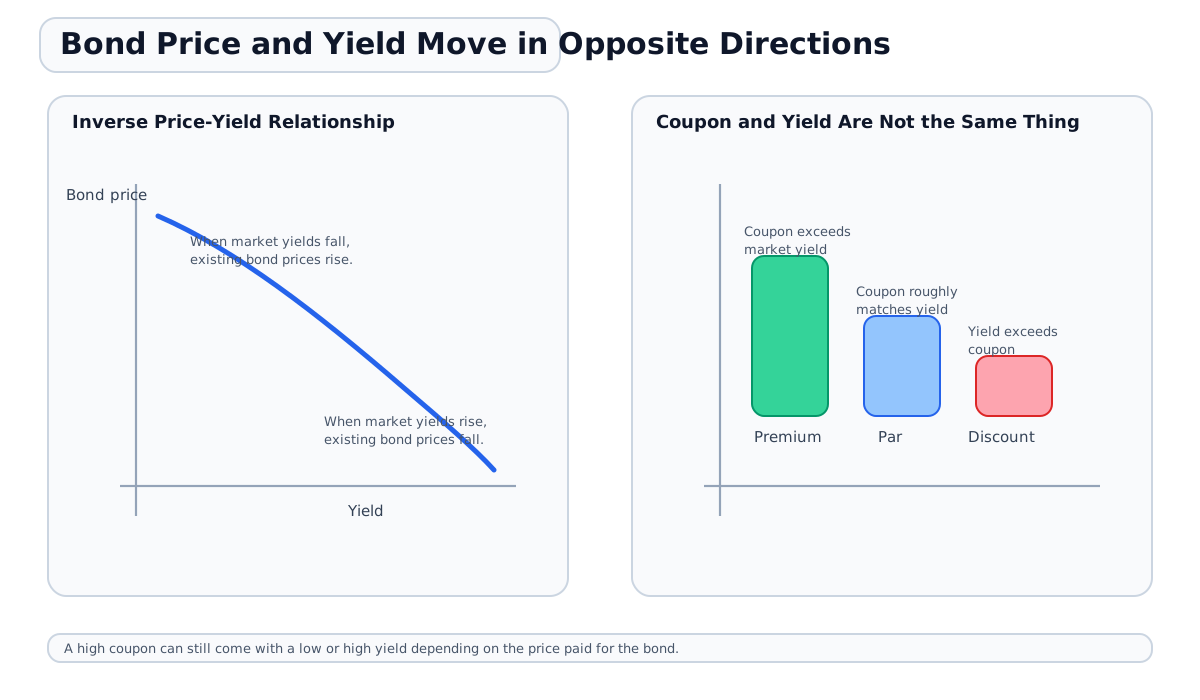
The SVG below adds the missing market geometry. It shows the inverse price-yield relationship and the premium, par, and discount comparison that often sits behind coupon-versus-yield mistakes.
Debt Markets Differ from Equity Markets
Debt trading in Canada differs from equity trading in important ways. Equity markets often provide more visible market pricing to retail investors, while debt pricing may be less transparent and more dependent on dealer quotations, inventory, market depth, and issue characteristics.
That difference matters because:
- liquidity may vary more meaningfully across debt instruments
- pricing may be harder for retail clients to interpret at a glance
- market access may depend more on the specific dealer platform or inventory available
For CIRE, the high-level lesson is that debt products often require a more deliberate review of pricing and liquidity conditions. Students should not assume that debt trades in the same visible and continuous way as widely traded equities.
Information Sources Help, but They Answer Different Questions
The curriculum expects students to identify the main information sources used in fixed income analysis:
- quotes
- credit ratings
- issuer disclosures
Each source serves a different purpose.
- Quotes help show available prices or yields, but they may change and may not fully explain the underlying risk.
- Credit ratings provide a useful shorthand for credit quality, but they are not a substitute for all due diligence.
- Issuer disclosures help explain the issuer’s condition, obligations, and risk factors.
The exam trap is to rely on any one of these in isolation. A strong rating does not eliminate interest-rate risk. A high quoted yield does not automatically mean the bond is attractive. A disclosure document may explain the issuer well but still leave liquidity or market-price concerns unresolved.
Active and Passive Fixed Income Management Involve Different Tradeoffs
Students should also compare active and passive bond-management approaches at a high level.
- Active fixed income management may seek to add value by adjusting duration, credit exposure, issuer selection, or sector weighting.
- Passive fixed income management generally aims to track a bond index or market segment.
Typical tradeoffs include:
- active management may respond more deliberately to changing market conditions, but often involves higher cost and manager-selection risk
- passive management may offer lower cost and benchmark clarity, but it remains exposed to the structure and concentration of the benchmark
As in equities, the strongest answer recognizes the tradeoff rather than claiming that one approach is categorically superior.
Coupon and Yield Are Related but Not Identical
One of the most important Chapter 7 fixed income distinctions is the difference between a bond’s coupon and its yield.
- The coupon refers to the stated interest payment rate or cash-flow pattern associated with the bond.
- The yield is the investor’s effective return measure based on market price and expected cash flows.
These can differ because bonds may trade at prices above or below their original issuance level. If a bond trades at a premium or discount, the income it pays may no longer align neatly with the investor’s effective return.
Students do not need advanced bond-math fluency to answer many CIRE questions correctly. They do need to understand the conceptual mistake in saying:
- “Higher coupon always means higher yield.”
That statement can be false if market price, maturity, and credit conditions differ.
Duration, Term, and Credit Quality Influence Bond Risk
Chapter 7 also expects students to identify the main components of assessing bond risk:
- term: the time to maturity or general maturity profile
- duration: a measure of sensitivity to interest-rate changes
- credit rating or credit quality: the issuer’s relative capacity to meet obligations
These are related but not identical concepts.
- A longer term often increases rate sensitivity, but structure matters.
- Duration is a more direct measure of rate sensitivity than term alone.
- Credit quality affects the compensation investors demand and therefore affects yields.
At a high level, bond yields may be affected by:
- general interest-rate levels
- issuer credit quality
- liquidity conditions
- time to maturity
Students should therefore be cautious with shorthand statements such as “high yield equals good income.” A higher yield may reflect higher compensation for higher risk.
Coupon Income and Tax Should Be Understood Conceptually
Coupons are periodic interest payments received by the bondholder under the bond’s terms. For CIRE, the important point is not detailed tax-rate memorization. It is that coupon income and market-value movements should be understood separately, and that tax treatment can matter conceptually when comparing products.
Students should know that a bond can:
- pay coupon income as expected
- still decline in market value if rates rise or credit conditions worsen
That distinction is fundamental in scenario analysis.
A Strong Fixed Income Analysis Starts with the Main Risk
A useful Chapter 7 sequence is:
- Identify the instrument type.
- Ask whether the main issue is rate risk, credit risk, liquidity risk, or reinvestment risk.
- Distinguish coupon from yield.
- Consider term, duration, and rating together rather than in isolation.
- Compare the product’s risk profile with the client’s purpose for using fixed income.
This sequence helps students avoid the common mistake of treating every bond-like product as a simple income solution.
Common Pitfalls
- Treating all fixed income products as low-risk substitutes for cash.
- Confusing coupon rate with effective yield.
- Ignoring the role of liquidity in debt trading.
- Treating credit ratings as a complete substitute for analysis.
- Assuming higher yield means a better investment without asking what risk is being compensated.
Key Terms
- Coupon: The stated interest payment rate or payment pattern on a bond.
- Yield: The investor’s effective return measure based on market price and expected cash flows.
- Duration: A measure of sensitivity to changes in interest rates.
- Credit risk: The risk that an issuer may not meet promised payments.
- Reinvestment risk: The risk that cash flows will have to be reinvested at lower rates.
Key Takeaways
- Fixed income includes several instrument types with different risk and liquidity profiles.
- Interest-rate, credit, liquidity, and reinvestment risk should be separated conceptually.
- Debt-market pricing can be less transparent and less liquid than equity pricing.
- Coupon and yield are related but not interchangeable.
- Term, duration, and credit quality all affect bond risk and yields.
Quiz
Sample Exam Question
A client seeking stable capital and modest income is considering two fixed income options. Option 1 is a long-duration lower-rated corporate bond fund with a high headline coupon. Option 2 is a short-term high-quality government bond strategy with a lower coupon. The representative recommends Option 1 solely because “higher coupon means higher return,” and does not discuss duration, credit quality, or the client’s short time horizon.
What is the strongest assessment?
- A. The recommendation is sound because coupon is the only fixed income measure that matters to investors.
- B. The recommendation is sound if the fund holds more than 20 issuers.
- C. The recommendation is weak because coupon and yield are not the same, and the client also faces duration and credit risk that may not fit a short-term stability objective.
- D. The recommendation is acceptable because all bond funds protect principal if held long enough.
Correct answer: C.
Explanation: The representative focused on one feature, the headline coupon, while ignoring the actual risk profile. A long-duration lower-rated corporate bond fund can expose the client to both interest-rate risk and credit risk, which may be inconsistent with a short time horizon and a capital-stability objective. Coupon does not equal effective return, and a diversified portfolio does not eliminate duration or credit sensitivity. Option D also overstates the protection available in bond funds.