Alternative Investments, ESG Products, and Other Non-Traditional Exposures
Review the key features, risks, disclosure issues, and escalation triggers for hedge funds, structured products, alternative funds, crypto assets, ESG-related products, and other non-traditional investments.
This section covers the products that often look appealing because they are novel, specialized, or heavily marketed, but that usually require stronger due diligence than conventional securities or ordinary pooled products. Chapter 7 expects students to identify the main product risks, ask the right disclosure and suitability questions, and recognize when escalation to specialists or additional approvals may be necessary.
The recurring exam issue is not whether the product sounds sophisticated. It is whether the representative has enough information and authority to discuss it responsibly.
What This Lesson Is Usually Testing
- Whether the candidate slows down when the product is novel, complex, or hard to value.
- Whether the candidate can identify the main structural risk quickly: liquidity, leverage, valuation, counterparty, or disclosure quality.
- Whether the candidate recognizes when specialist review or internal approval is required.
- Whether the candidate resists marketing language and returns to product structure and client fit.
Common Clue -> Stronger Answer Direction
| If the stem emphasizes | Stronger answer direction |
|---|---|
| Complex payoff, barriers, caps, or note features | Shift into structured-product risk, issuer exposure, and disclosure analysis |
| Volatility plus platform, custody, or fraud concerns | Treat crypto as an operational and protection issue, not just a price issue |
| ESG claim, product name, or sustainability promise | Test whether disclosure actually supports the marketing message |
| Restricted access, unusual approvals, or unclear platform status | Escalate to specialist or supervisory review |
| Client excitement about innovation or high return | Re-center the answer on due diligence and suitability, not enthusiasm |
What Stronger Answers Usually Do
- Identify the main source of non-traditional risk before comparing performance.
- Ask whether the representative even has enough basis and authority to proceed.
- Escalate when structure, disclosure, or access rules are unclear.
- Treat investor protection and operational risk as part of the suitability discussion.
Why Non-Traditional Products Need Extra Caution
Non-traditional products often differ from conventional investments in one or more important ways:
- valuation may be less transparent
- liquidity may be weaker
- payoff structure may be more complex
- leverage or counterparty exposure may be embedded
- disclosure may be harder for clients to interpret
These features do not automatically make the product inappropriate. They do mean that the representative should slow down the analysis, ask more questions, and be alert to approval or escalation requirements.
Hedge Funds, Structured Products, Alternative Funds, and Crypto Assets Each Raise Distinct Risks
Students should be able to identify the main features and return drivers at a high level.
Hedge Funds
Hedge funds may use strategies that are more flexible, more concentrated, or more complex than conventional retail-oriented products. They may involve short selling, leverage, derivatives, or less liquid holdings. The main exam point is that strategy flexibility can increase both opportunity and risk.
Structured Products
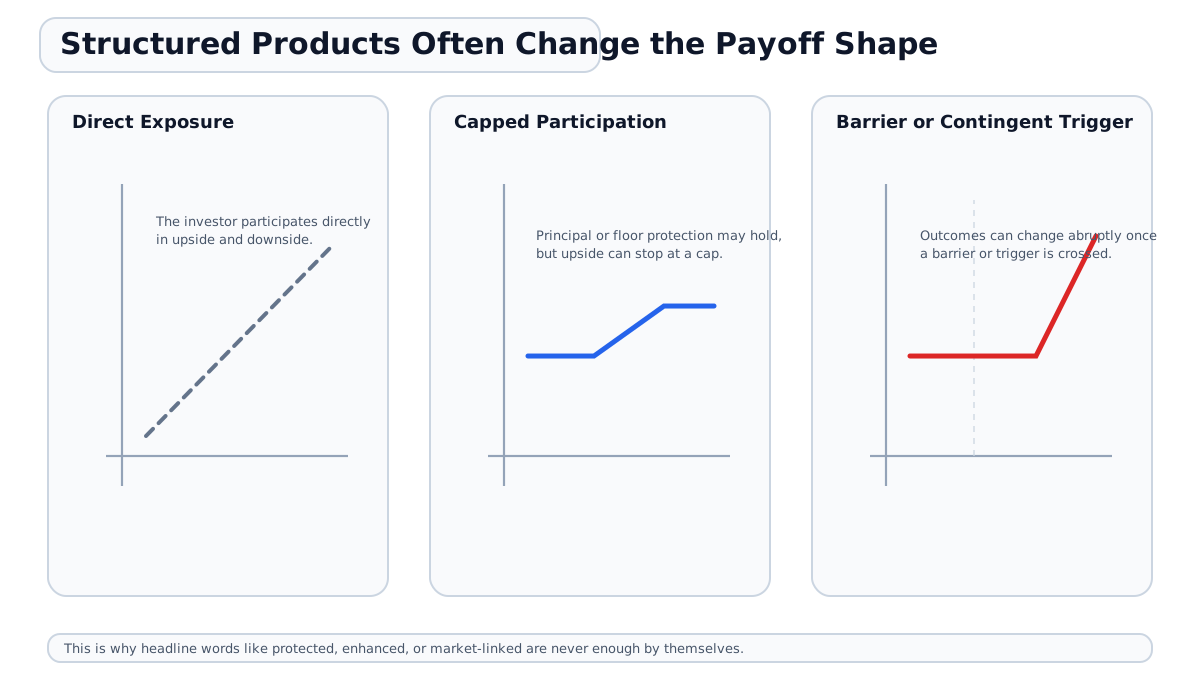
Structured products often combine debt-like or note-like features with returns linked to an underlying asset, index, rate, or other reference. They can look simple in marketing summaries, but investor outcomes may depend on caps, barriers, participation rates, issuer strength, and payoff conditions.
Alternative Investment Funds
Alternative funds can provide exposure to strategies or asset classes outside conventional long-only investing. The key issue is not the label “alternative” by itself. It is whether the client and representative understand liquidity, leverage, concentration, and the intended role of the product.
Crypto Assets
Crypto assets and crypto-linked exposures are high-risk and may be volatile, difficult to value, or vulnerable to fraud, hacking, platform failure, and weak investor protections. The strongest answer recognizes that crypto risk is not only price volatility. It also includes custody, platform, conduct, and protection-fund concerns.
The right Chapter 7 lens is comparative. If a product’s features make valuation, liquidity, or investor protection less predictable, more diligence is required before it is presented as suitable.
    flowchart TD
	    A[Non-traditional product proposed] --> B{Key risk lens}
	    B -->|Liquidity or valuation uncertainty| C[Deepen due diligence]
	    B -->|Leverage or counterparty exposure| D[Check specialist controls]
	    B -->|Marketing or disclosure concern| E[Review product documents carefully]
	    B -->|Client-category or approval issue| F[Escalate internally]
	    C --> G[Suitability decision]
	    D --> G
	    E --> G
	    F --> G
The diagram matters because the right response to a complex product is usually a controlled review process, not a quick product comparison based on headline returns.
The SVG below shows why structured products inside this category need extra care. The same marketing language can hide very different payoff modifiers such as caps, floors, and contingent barriers.
ESG Products Require Clear and Supportable Disclosure
ESG-related products are often marketed by reference to environmental, social, or governance objectives or strategies. For CIRE, the key lesson is not to debate the value of ESG investing in the abstract. It is to recognize that ESG claims must be supported by clear disclosure and that misleading claims create conduct risk.
Students should be alert to questions such as:
- what ESG objective or strategy is actually being used?
- is the strategy central or only one factor among many?
- do the product name and marketing claims match the disclosed investment approach?
- are exclusions, screens, stewardship claims, or impact claims explained clearly?
If the marketing language is broad but the disclosure is vague, the product may raise a greenwashing concern or at least a disclosure-quality concern.
Due Diligence for Non-Traditional Products Is Question-Driven
When the product is less conventional, the representative should focus on the most important due-diligence questions:
- How liquid is the product?
- How is it valued?
- Is leverage used directly or indirectly?
- Is there meaningful counterparty exposure?
- What fees or embedded charges affect returns?
- What disclosure is available and how clear is it?
These questions are often more important than recent performance. A product can have attractive historical results and still be a weak fit if the client cannot tolerate the structure’s liquidity, opacity, or downside profile.
Suitability Requires More Than Client Enthusiasm
A common exam trap is a client who wants a sophisticated product simply because it sounds innovative or promises higher returns. The stronger answer recognizes that client enthusiasm does not reduce the representative’s due-diligence burden.
For example:
- a client interested in crypto still needs discussion of volatility, platform risk, and loss of protections
- a client attracted to a structured product still needs explanation of payoff conditions, issuer exposure, and liquidity
- a client interested in an ESG product still needs supportable disclosure showing what the strategy really does
The correct response is not to block complexity automatically. It is to validate that the product’s structure is understood and genuinely appropriate.
Client Category, Product Access, and Specialist Escalation May Matter
Some non-traditional products raise internal approval or product-access questions. A representative may need to determine:
- whether the product is approved on the firm’s platform
- whether the client category permits access
- whether specialist review is required
- whether compliance, supervision, or product specialists should be involved
This is especially important when the product involves:
- complex or contingent payoffs
- restricted access
- significant leverage
- unusual valuation practices
- marketing claims that may be hard to support
The strongest answer in a scenario question often includes escalation when the representative lacks enough basis to proceed confidently.
Marketing Material Is Not a Substitute for Product Understanding
Students should be cautious when a fact pattern relies heavily on brochures, social media content, promotional summaries, or third-party rankings. These may be relevant, but they are not enough by themselves to support product due diligence.
The representative should anchor the discussion in:
- actual product disclosure
- firm-approved materials
- the product’s real structural features
- internal approval and supervision rules where applicable
This is particularly important for crypto-linked products and ESG-related claims, where marketing language can overstate protection, stability, or alignment.
A Strong Answer Uses an Escalation Mindset
A useful Chapter 7 process for non-traditional products is:
- Identify the product type and the main return driver.
- Identify the biggest structural risks: liquidity, valuation, leverage, counterparty, or disclosure quality.
- Determine whether the client appears able to understand and bear those risks.
- Check whether platform, approval, or client-category issues require specialist involvement.
- Escalate when the structure or disclosure is too complex for ordinary treatment.
This process helps students avoid the weak instinct to treat complexity as either obviously good or obviously bad.
Common Pitfalls
- Treating novelty as a substitute for suitability.
- Relying on marketing language instead of on actual product disclosure and structure.
- Ignoring liquidity, valuation, or counterparty risk because recent returns look attractive.
- Treating ESG labels as self-proving rather than asking whether disclosure supports the claim.
- Failing to escalate when the product or client-access question exceeds ordinary representative judgment.
Key Terms
- Structured product: An investment with returns linked to one or more underlying references and shaped by defined payoff conditions.
- Counterparty risk: The risk that the other party to a transaction or arrangement may fail to perform.
- Alternative fund: A fund using non-conventional strategies or exposures relative to ordinary long-only structures.
- Crypto asset: A digital asset that may involve significant volatility, platform risk, custody risk, and investor-protection concerns.
- Greenwashing: Marketing or disclosure that overstates or misrepresents ESG-related features or benefits.
Key Takeaways
- Non-traditional products usually require deeper due diligence than conventional products.
- Hedge funds, structured products, alternatives, and crypto assets raise different combinations of liquidity, leverage, valuation, and protection concerns.
- ESG claims should be supported by clear disclosure and consistent product messaging.
- Client enthusiasm does not replace suitability analysis or product diligence.
- Specialist escalation is often the strongest response when access, complexity, or disclosure creates uncertainty.
Quiz
Sample Exam Question
A representative is asked about a note that promises returns tied to a crypto-related basket and is marketed as an ESG-conscious solution because part of the issuer’s promotional material highlights sustainability themes. The client is interested because the product appears innovative and the brochure emphasizes upside potential. The representative relies mainly on the brochure, does not review the detailed payoff conditions, does not assess liquidity or issuer exposure, and does not escalate the product to a specialist even though the structure is new to the branch.
What is the strongest assessment?
- A. The representative may proceed because strong client interest removes the need for additional due diligence.
- B. The representative should pause, review the product’s actual structure and disclosures, assess liquidity and counterparty risk, and escalate internally before discussing suitability further.
- C. The product is automatically suitable if it combines ESG language with crypto-related upside.
- D. The only relevant question is whether the recent return outlook is higher than that of a mutual fund.
Correct answer: B.
Explanation: The fact pattern raises multiple control concerns: a structured payoff, crypto-linked exposure, promotional ESG language, and unfamiliarity within the branch. Those facts require deeper due diligence and likely specialist or supervisory involvement before the representative can discuss suitability responsibly. Option B identifies the required process response. Options A, C, and D all confuse client enthusiasm or marketing language with product understanding.