Spreads, income strategies, and volatility strategies
Use spread, income, and volatility strategies by matching market view, premium profile, and risk shape to the scenario.
Spreads, income strategies, and volatility strategies appears in the official CIRO Derivatives Exam syllabus as part of Speculating, hedging and other investment strategies. Questions here usually test whether you can recognize the payoff family that matches the market view instead of defaulting to a simple bullish or bearish trade.
Strategy Families Matter More Than Memorized Labels
This section is where the exam shifts from single-position logic to structured combinations. A spread narrows the view and narrows the payoff. An income strategy usually trades away some upside or takes on contingent downside in exchange for premium. A volatility strategy is often less about market direction than about how far and how fast the underlying is likely to move.
That is why the stronger answer usually asks what kind of shape the investor needs. Is the view moderately bullish, moderately bearish, range-bound, or centered on a large move in either direction? Once the shape is identified, the strategy family is usually easier to defend.
Strategy Comparison
| Strategy family | Market view | Premium profile | Main risk |
|---|---|---|---|
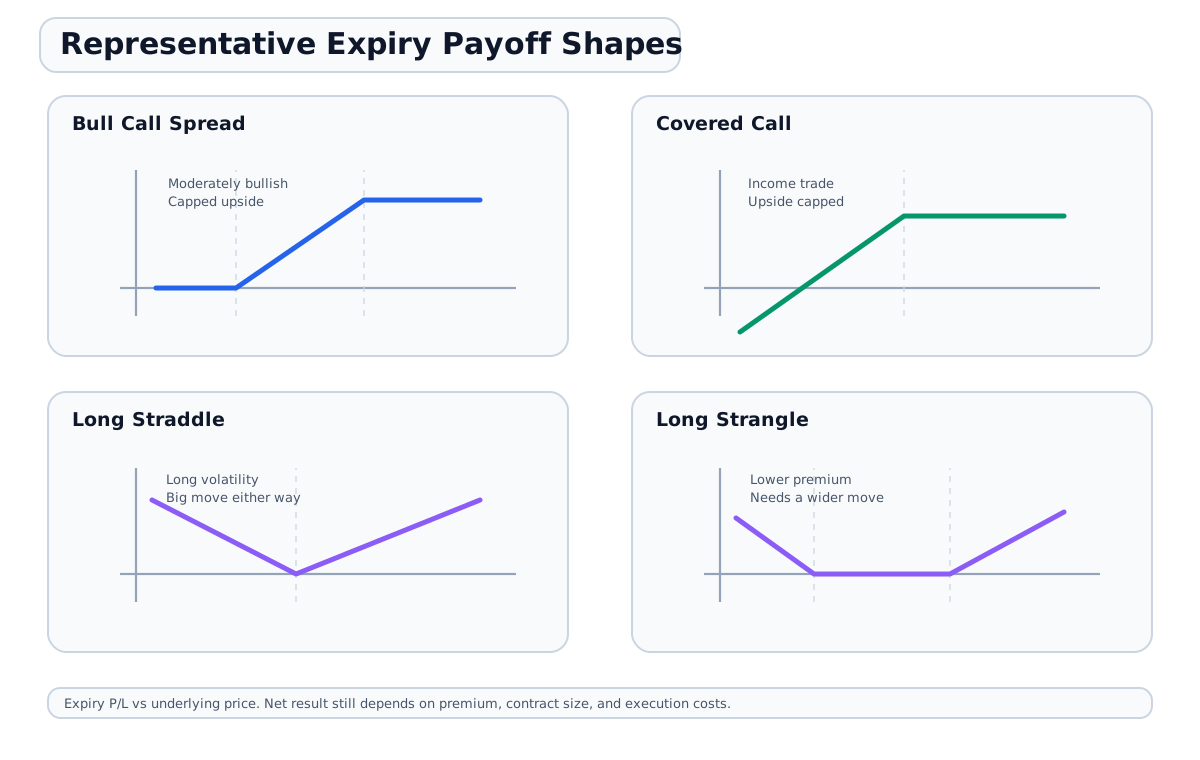
| Vertical spread | Moderately bullish or bearish | Lower net premium than an outright long option | Profit is capped if the move is larger than expected |
| Covered call or other income trade | Neutral to mildly bullish | Receives premium up front | Upside is capped and downside in the underlying remains |
| Straddle | Big move expected, direction uncertain | Expensive because both options are near the money | Time decay hurts if the underlying stays quiet |
| Strangle | Big move expected, direction uncertain | Cheaper than a straddle | Requires a larger move to become profitable |
The figure below is worth keeping as an SVG because this lesson depends on the exact expiry payoff geometry, not just a decision flow.
Use The Shape To Eliminate Wrong Answers
If the case says the investor wants income from a position they already own, a covered-call style answer should move to the front of the line. If the case says the investor expects a sharp move but is unsure of direction, a long volatility structure should dominate. If the case says the view is directional but only moderately so, a spread is often stronger than an outright premium-heavy long option.
The exam often penalizes candidates who choose a powerful strategy that solves the wrong problem. A long straddle can profit from a big move, but it is a poor answer if the real objective is premium income from a quiet market. A covered call can generate cash flow, but it is a weak answer if the investor needs uncapped upside.
Learning Objectives
- Analyze spread strategies using futures, forwards, and similar derivatives, including basis, inter-commodity, and intra-commodity spreads.
- Recognize the main risks related to spread strategies.
- Analyze volatility strategies using futures, forwards, or similar derivatives.
- Analyze income-producing strategies using options or similar derivatives.
- Analyze vertical spread strategies using options or similar derivatives.
- Analyze options volatility strategies such as straddles and strangles.
- Choose the most suitable spread, income, or volatility strategy for a stated market view and risk profile.
- Interpret the payoff or risk implication of a spread, straddle, or strangle scenario using provided facts.
Exam Angle
The stronger answer usually identifies the market view first: range-bound, moderately directional, or expecting a large move. Then it chooses the strategy family whose payoff shape matches that view and whose risk profile the investor can actually tolerate.
Key Takeaways
- Use spreads when the view is narrower than an outright bullish or bearish call.
- Use income strategies only when the premium received is worth the capped upside or contingent downside.
- Use volatility strategies when move size matters more than direction, and remember that quiet markets can be the biggest risk to the long-premium trade.