Bond Pricing, Yield Measures, Duration, Yield Curves, and Time Value of Money
Learn how to calculate and interpret key fixed-income measures, including bond yields, price sensitivity, duration, and present value.
This section covers the analytical side of fixed income. For RSE purposes, students must be able not only to calculate yields, duration, and present value, but also to explain what those results mean for client risk, pricing, and recommendation quality. A correct number without correct interpretation is usually not enough.
Fixed-income calculations often test a chain of reasoning. Students may need to identify whether a bond is trading at a premium or discount, determine which yield measure is relevant, estimate how price may respond to rate changes, and explain why the answer matters for a client’s horizon or risk tolerance. The strongest answer therefore combines arithmetic and judgment.
Yield Measures Describe Return in Different Ways
The curriculum expects students to calculate and interpret current yield, approximate yield to maturity, and zero-coupon yield.
Current Yield
Current yield compares the annual coupon to the current market price.
\[ \text{Current Yield} = \frac{C}{P} \]Here, \( C \) is the annual coupon payment and \( P \) is the current bond price.
Current yield is useful because it quickly shows the coupon income being earned relative to price paid. However, it does not capture the capital gain or loss from the bond moving toward par at maturity.
Approximate Yield to Maturity
Approximate yield to maturity adds the annualized pull-to-par effect to coupon income and then compares that combined amount with the average of price and par.
\[ \text{Approximate YTM} = \frac{C + \frac{F-P}{n}}{\frac{F+P}{2}} \]Here, \( F \) is face value and \( n \) is years to maturity.
Approximate YTM is stronger than current yield because it captures both:
- coupon income
- the effect of buying at a discount or premium
It is still an approximation, not a full internal-rate-of-return calculation, but it is often exactly what the exam expects.
Zero-Coupon Yield
A zero-coupon bond has no interim coupon. Its return comes from the difference between purchase price and maturity value.
\[ \text{Zero-coupon yield} = \left(\frac{F}{P}\right)^{1/n} - 1 \]The exam point is simple: with a strip or other zero-coupon instrument, there is no current coupon income, so yield is entirely a function of discount and maturity value.
Price, Premium, Discount, and Pull to Par
Students should connect yield measures to where the bond trades relative to par.
- If price is below par, the bond trades at a discount.
- If price is above par, the bond trades at a premium.
- If price equals par, the bond trades at par.
This matters because:
- a discount bond usually has a yield to maturity above its coupon rate
- a premium bond usually has a yield to maturity below its coupon rate
- current yield may sit above or below coupon depending on price
A common exam trap is to confuse coupon with total expected return. Coupon is only one part of the result.
Yield Curves Help Interpret the Rate Environment
The curriculum also expects students to interpret yield curves at a high level.
Normal, Flat, and Inverted Curves
A normal upward-sloping curve generally suggests higher yields for longer maturities. A flat curve suggests little extra yield for extending maturity. An inverted curve means shorter maturities yield more than longer maturities.
At an exam level, students should connect these shapes to broad expectations:
- a normal curve is often associated with ordinary term compensation
- a flat curve can suggest transition or uncertainty
- an inverted curve is often associated with expectations of weaker future growth or lower future rates
These are informed interpretations, not guarantees.
Steepening and Flattening
A curve can also change shape over time.
- Steepening means the yield gap between short and long maturities is widening.
- Flattening means that gap is narrowing.
Students should describe the likely implication for maturity exposure and interest-rate risk without claiming certainty about future macro outcomes.
This part of the curriculum is easier to remember when the student can see the three recurring visuals behind the formulas.
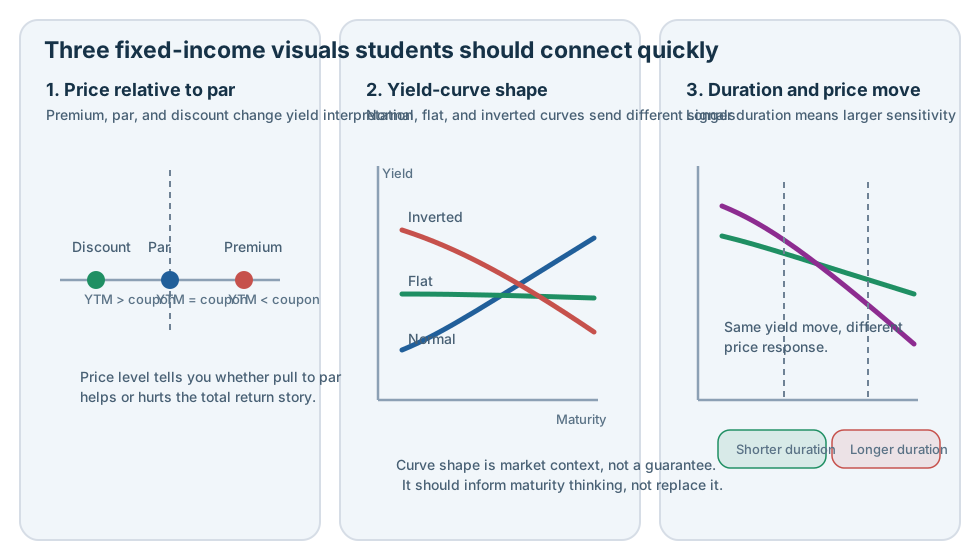
The figure is not a substitute for the calculations. It is a memory aid for the ideas students must connect quickly: price relative to par changes yield interpretation, the curve sets the maturity context, and duration explains why the same rate move can produce different price effects.
Coupon, Term, and Yield Affect Price Sensitivity
Bond prices move inversely to yields. If yields rise, bond prices tend to fall. If yields fall, bond prices tend to rise.
The magnitude of that price change depends on several factors, including:
- term to maturity
- coupon level
- yield level
- cash-flow timing
At a high level:
- longer term usually means greater price sensitivity
- lower coupon usually means greater price sensitivity
- bonds with more distant cash flows tend to be more rate sensitive
That is why a long strip is usually much more volatile than a short, high-coupon bond.
Macaulay Duration and Modified Duration Are Related but Not Identical
The curriculum expects students to distinguish Macaulay duration from modified duration.
Macaulay Duration
Macaulay duration measures the weighted average timing of the bond’s cash flows. It is a timing measure.
For interpretation purposes:
- coupon bonds usually have Macaulay duration shorter than maturity
- a zero-coupon bond has Macaulay duration equal to maturity
Modified Duration
Modified duration adapts the Macaulay concept into a price-sensitivity measure.
\[ \text{Modified Duration} = \frac{\text{Macaulay Duration}}{1+y} \]Here, \( y \) is the relevant yield expressed for the same compounding basis used in the duration setup.
The important conceptual distinction is:
- Macaulay duration describes weighted timing of cash flows
- modified duration estimates how sensitive price is to a small change in yield
Students should not use the two terms as if they are interchangeable.
Modified Duration Estimates Price Change
Once modified duration is known, it can be used to approximate the percentage price change for a small yield movement.
\[ \frac{\Delta P}{P} \approx -D_{\text{mod}} \times \Delta y \]This formula implies:
- the negative sign reflects the inverse relationship between price and yield
- higher modified duration means greater price sensitivity
- the estimate works best for relatively small yield changes
For example, if modified duration is 5 and yields rise by 1%, the estimated price change is about:
\[ \frac{\Delta P}{P} \approx -5 \times 0.01 = -0.05 \]That is about a 5% price decline.
Students should explain the sign correctly. A frequent exam error is getting the direction backward.
Time Value of Money Explains Bond Valuation
A fixed-income security is worth the present value of its future cash flows discounted at the required rate of return.
\[ P = \sum_{t=1}^{n} \frac{CF_t}{(1+r)^t} \]Here:
- \( CF_t \) is the cash flow in period \( t \)
- \( r \) is the discount rate
- \( n \) is the number of periods
For a standard coupon bond, those cash flows usually include:
- periodic coupon payments
- final principal repayment at maturity
If the discount rate rises, the present value of those cash flows falls. That is the basic economic reason bond prices decline when required yields rise.
A Practical Exam Method for Fixed-Income Calculations
When a calculation question appears, a useful sequence is:
- identify what is being asked: yield, duration, price change, or present value
- extract the needed inputs carefully
- choose the correct formula
- calculate the result with the correct sign and units
- explain what the result means for price, risk, or client fit
This helps avoid the common mistake of using a correct formula for the wrong question.
Common Pitfalls
- Confusing coupon rate with current yield or yield to maturity.
- Forgetting that premium and discount status affects yield interpretation.
- Interpreting yield-curve changes as guarantees instead of informed market inferences.
- Mixing up Macaulay duration and modified duration.
- Forgetting the negative sign when using duration to estimate price change after a yield increase.
Key Terms
- Current yield: Annual coupon divided by current price.
- Yield to maturity: The return measure that reflects coupon cash flows and pull to par if held to maturity.
- Yield curve: A comparison of yields across maturities.
- Macaulay duration: Weighted average timing of a bond’s cash flows.
- Modified duration: An estimate of price sensitivity to a small change in yield.
- Present value: The current value of future cash flows discounted at a required rate.
Key Takeaways
- Different yield measures answer different questions, so choosing the right one matters.
- Premium and discount pricing directly affect yield interpretation.
- Longer maturity and lower coupon usually increase interest-rate sensitivity.
- Macaulay duration is a timing measure, while modified duration is a price-sensitivity measure.
- Present-value logic explains why bond prices fall when discount rates rise.
Quiz
Sample Exam Question
A representative is reviewing two bonds for a client who may need to sell within three years if business capital is required. Bond X is a long-term strip trading at a discount. Bond Y is a shorter-term coupon bond with a lower duration. The representative tells the client that Bond X is preferable because its current yield appears higher and because all fixed-income securities become safer when purchased below par. The representative also estimates that if yields rise by 1%, Bond X will gain value because discount bonds move toward par.
What is the strongest assessment?
- A. The representative is correct because discount bonds always rise in price when market yields rise.
- B. The representative is correct because current yield captures the full return and risk picture better than duration.
- C. The representative is correct because strips eliminate all interest-rate risk.
- D. The representative’s analysis is weak because current yield is incomplete, a long strip is usually highly rate-sensitive, and rising yields would generally reduce price despite eventual pull to par.
Correct answer: D.
Explanation: The scenario combines several analytical mistakes. Current yield does not capture the full return profile, especially for a strip. A long strip usually has very high duration and therefore substantial price sensitivity to interest-rate changes. If yields rise, price generally falls, even though the bond would still move toward par over time if held to maturity. For a client with a possible sale need in three years, the shorter-duration bond may be easier to defend.