Intrinsic Value and Time Value in Options
Understand the two main components of an option’s premium and how they change as market conditions evolve.
6.4 Intrinsic Value and Time Value
In the world of options trading, understanding the concepts of intrinsic value and time value is crucial for evaluating and making informed decisions about options contracts. These two components are fundamental in determining the premium, or price, of an option. Let’s delve into these concepts, explore their significance, and learn how they affect options trading.
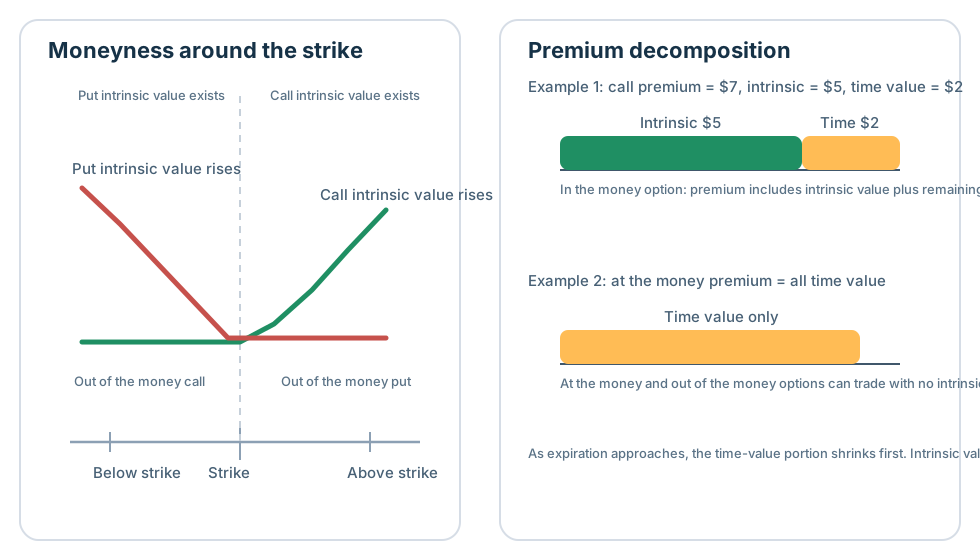
This SVG separates the two core ideas on the page: where intrinsic value exists relative to the strike, and how an observed premium can be decomposed into intrinsic value plus time value.
Understanding Intrinsic Value
Intrinsic Value is the real, tangible value of an option if it were to be exercised immediately. It represents the difference between the current price of the underlying asset and the option’s strike price. Intrinsic value is only applicable to options that are “in the money” (ITM).
Call Option Intrinsic Value: For a call option, the intrinsic value is calculated as the current price of the underlying asset minus the strike price of the option. If the result is positive, the option has intrinsic value. If the result is negative or zero, the option has no intrinsic value.
Formula:
\[ \text{Intrinsic Value (Call)} = \max(0, \text{Current Price of Underlying} - \text{Strike Price}) \]Put Option Intrinsic Value: For a put option, the intrinsic value is calculated as the strike price of the option minus the current price of the underlying asset. Again, if the result is positive, the option has intrinsic value.
Formula:
\[ \text{Intrinsic Value (Put)} = \max(0, \text{Strike Price} - \text{Current Price of Underlying}) \]
Example Calculation of Intrinsic Value
Suppose you own a call option on Company XYZ with a strike price of $50, and the current market price of XYZ stock is $55. The intrinsic value of this call option is:
\[ \text{Intrinsic Value} = \max(0, 55 - 50) = 5 \]For a put option with a strike price of $50, if the current market price of XYZ stock is $45, the intrinsic value would be:
\[ \text{Intrinsic Value} = \max(0, 50 - 45) = 5 \]Exploring Time Value
Time Value is the portion of the option’s premium that exceeds its intrinsic value, reflecting the potential for the option to increase in value before expiration. It accounts for the uncertainty and time remaining until the option’s expiration date. The longer the time until expiration, the greater the time value, as there is more opportunity for the underlying asset’s price to move favorably.
- Factors Influencing Time Value:
- Time to Expiration: More time until expiration generally results in higher time value.
- Volatility: Higher volatility increases the likelihood of significant price movements, enhancing time value.
- Interest Rates: Changes in interest rates can affect the cost of carrying the underlying asset, influencing time value.
- Dividends: Expected dividends can impact the time value of options, particularly for call options.
Formula for Time Value
The time value of an option can be calculated as the difference between the option’s premium and its intrinsic value:
\[ \text{Time Value} = \text{Option Premium} - \text{Intrinsic Value} \]Example Calculation of Time Value
Continuing with the previous example, assume the premium for the call option on Company XYZ is $7. The intrinsic value is $5, as calculated earlier. Therefore, the time value of the option is:
\[ \text{Time Value} = 7 - 5 = 2 \]How Intrinsic and Time Values Affect Option Premiums
The premium of an option, which is the price paid by the buyer to the seller, is composed of both intrinsic value and time value. Understanding how these components interact is essential for evaluating options.
- In-the-Money (ITM) Options: These options have intrinsic value. The premium includes both intrinsic and time value.
- At-the-Money (ATM) Options: These options have no intrinsic value, as the strike price is equal to the current price of the underlying asset. The premium is entirely time value.
- Out-of-the-Money (OTM) Options: These options also have no intrinsic value. The premium is purely time value.
Practical Applications and Strategies
Understanding intrinsic and time values is vital for developing effective options trading strategies. Here are some practical applications:
- Hedging: Investors can use ITM options to hedge against adverse price movements, as these options possess intrinsic value.
- Speculation: Traders might buy OTM options with high time value to speculate on significant price changes in the underlying asset.
- Income Generation: Selling options with high time value can generate income, especially if the options expire worthless.
Real-World Example: Options on Tech Stocks
Consider an investor interested in options on a tech stock, such as Apple Inc. (AAPL). Suppose AAPL is trading at $150, and the investor buys a call option with a strike price of $145 for a premium of $10. The intrinsic value is:
\[ \text{Intrinsic Value} = \max(0, 150 - 145) = 5 \]The time value is:
\[ \text{Time Value} = 10 - 5 = 5 \]The investor anticipates further price increases in AAPL, which could increase the intrinsic value and potentially the overall premium of the option.
Conclusion
Intrinsic value and time value are fundamental concepts in options trading, influencing the pricing and valuation of options contracts. By understanding these components, you can better assess the potential profitability and risk of options strategies. Whether you’re hedging, speculating, or generating income, mastering intrinsic and time values will enhance your ability to navigate the options market effectively.