Core Terms in an Option Contract
Learn the essential option terms, including strike price, expiration date, and premium, and why they matter.
6.2 Key Terms: Strike Price, Expiration Date, Premium
Options trading can appear complex at first glance, but understanding its key terms can simplify the process significantly. In this section, we will delve into three critical components of an options contract: the strike price, the expiration date, and the premium. Each of these elements plays a vital role in determining the value and strategy of an option, and mastering these concepts is essential for anyone preparing for US Securities Exams or looking to navigate the financial markets effectively.
Understanding the Strike Price
Strike Price (Exercise Price): The strike price is the predetermined price at which the option holder can buy (in the case of a call option) or sell (in the case of a put option) the underlying asset. It serves as the benchmark for determining whether an option is in-the-money, at-the-money, or out-of-the-money.
- In-the-Money (ITM): For a call option, when the market price of the underlying asset is above the strike price. For a put option, when the market price is below the strike price.
- At-the-Money (ATM): When the market price of the underlying asset is equal to the strike price.
- Out-of-the-Money (OTM): For a call option, when the market price is below the strike price. For a put option, when the market price is above the strike price.
The strike price is crucial because it determines the intrinsic value of the option. Intrinsic value is the real, tangible value of an option if it were exercised immediately. For example, if you hold a call option with a strike price of $50 and the current market price of the underlying asset is $60, the intrinsic value of the option is $10.
Visual Aid: Option Payoff Diagram for Call Options
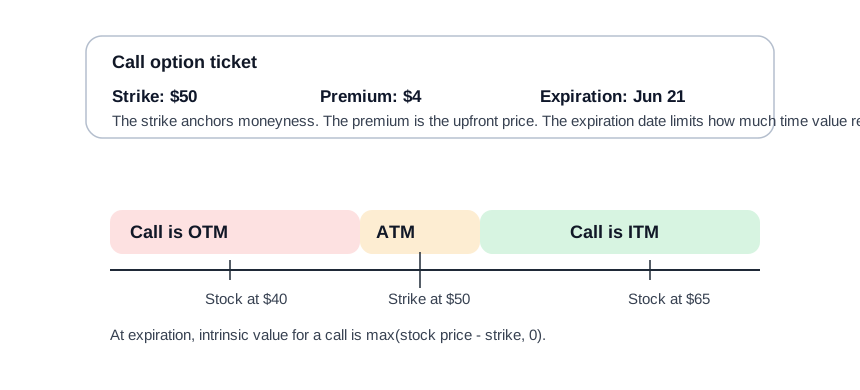
This diagram ties contract anatomy to moneyness so the strike price can be interpreted in price context rather than as an isolated definition.
The Expiration Date Explained
Expiration Date: The expiration date is the last day on which the option can be exercised. After this date, the option becomes void and worthless. The time remaining until expiration is a critical factor in an option’s time value, which is part of the option’s premium.
- American Options: Can be exercised at any time up to the expiration date.
- European Options: Can only be exercised on the expiration date itself.
The expiration date affects the option’s time value, which decreases as the expiration date approaches. This phenomenon is known as time decay or theta decay. As an option nears its expiration, its time value diminishes, potentially impacting the overall premium of the option.
Visual Aid: Time Decay in Options
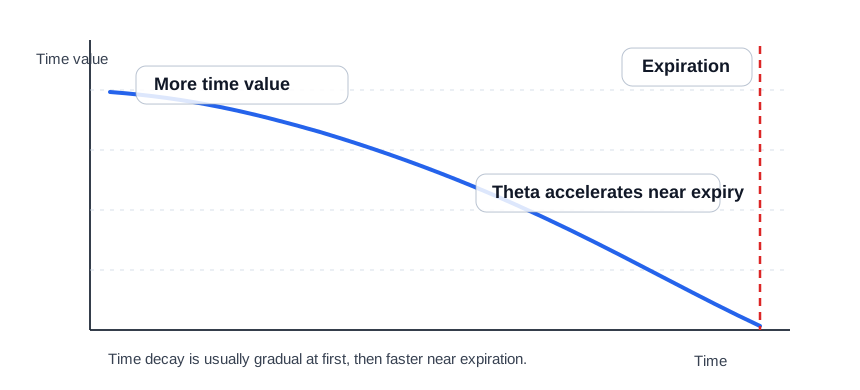
This diagram shows the key practical point of time decay: the time-value portion of the premium usually erodes fastest near expiration.
Exploring the Premium
Premium: The premium is the price paid by the buyer to the seller to acquire the option. It consists of two components: intrinsic value and time value. The premium is influenced by several factors, including the underlying asset’s price, the strike price, the time until expiration, volatility, and interest rates.
- Intrinsic Value: The difference between the underlying asset’s market price and the strike price, if favorable to the option holder.
- Time Value: The additional amount paid over the intrinsic value, reflecting the potential for future profitability.
The premium is a crucial consideration for both buyers and sellers of options. Buyers pay the premium to gain the right to exercise the option, while sellers receive the premium as compensation for taking on the obligation to fulfill the contract if the buyer exercises their right.
Factors Affecting Option Premium
- Underlying Asset Price: Changes in the asset’s price can significantly impact the premium.
- Volatility: Higher volatility increases the premium due to greater potential for price swings.
- Time to Expiration: More time until expiration generally increases the premium due to greater opportunity for the asset’s price to move favorably.
- Interest Rates: Changes in interest rates can affect the time value component of the premium.
How These Terms Affect Option Value and Strategy
Understanding the interplay between the strike price, expiration date, and premium is vital for developing effective options trading strategies. Here are some ways these terms influence option value and strategy:
- Strike Price Selection: Choosing the right strike price is essential for aligning with your market outlook and risk tolerance. A lower strike price for call options or a higher strike price for put options generally increases the likelihood of the option being in-the-money.
- Expiration Date Considerations: Longer expiration dates provide more time for the underlying asset to move favorably, but they also come with higher premiums. Shorter expiration dates may offer lower premiums but require more precise timing.
- Premium Evaluation: Assessing whether the premium is justified based on the intrinsic and time values helps determine the potential profitability of the option. A high premium may require a significant move in the underlying asset to be profitable.
Practical Example: Call Option Strategy
Imagine you are considering purchasing a call option for Company XYZ, which is currently trading at $100. You have the following options:
- Option A: Strike Price of $95, Expiration in 1 month, Premium of $8.
- Option B: Strike Price of $105, Expiration in 3 months, Premium of $5.
- Option A is in-the-money and has a higher premium due to its intrinsic value. It offers immediate profitability if the market price remains above the strike price but comes with a higher upfront cost.
- Option B is out-of-the-money but provides more time for the market price to rise above the strike price. It has a lower premium, reflecting its speculative nature.
Your choice will depend on your market outlook, risk tolerance, and strategy. If you expect a significant price increase, Option B might offer higher returns for a lower initial investment.
Conclusion
Mastering the concepts of strike price, expiration date, and premium is essential for anyone involved in options trading. These terms form the foundation of option valuation and strategy, influencing decisions and potential outcomes. By understanding how these elements interact, you can develop more informed trading strategies and enhance your ability to navigate the financial markets.