Mathematical Calculations and Methods
Study the municipal math and yield methods tested on Series 52, including accrued interest, premiums and discounts, and yield comparisons.
Series 52 does not treat municipal math as a separate memorization game. The calculations are tested because representatives need to compare municipal issues, explain pricing, and understand how yield, premium, discount, and accrued-interest conventions affect a customer’s actual trade result.
The exam often turns simple math into a concept question. If a bond trades at a premium, discount, or different yield basis, the candidate needs to know what that says about coupon level, price behavior, and relative value. Municipal math is most manageable when you connect the calculation to the pricing story rather than trying to memorize isolated formulas.
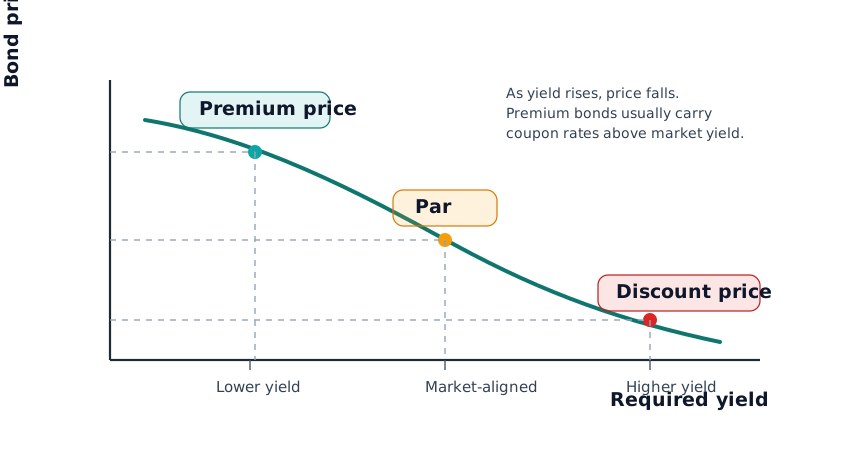
The figure shows the exam relationship that appears again and again: as required yield rises, price falls. Premium, par, and discount language is just a quick way to describe where the bond is sitting on that curve relative to its coupon.
What Series 52 Math Is Testing
Series 52 math is mostly about translating quotation language into customer meaning. A representative should be able to look at a municipal bond quote and understand whether the customer is paying above par or below par, how much accrued interest is owed, and why the stated yield may differ from the coupon rate.
The exam usually rewards relationship thinking more than calculator speed. If the bond is priced above par, the coupon is usually richer than prevailing market yield. If it is below par, the market is demanding more yield than the bond’s coupon alone provides. Once that logic is clear, many formula questions become much easier.
Core Relationships
| Trading status | Typical relationship | What the representative should infer |
|---|---|---|
| Premium bond | Coupon rate is above current market yield | The bond pays relatively high interest, so buyers pay more than par. |
| Par bond | Coupon rate is close to current market yield | The bond’s stated coupon is broadly aligned with current market conditions. |
| Discount bond | Coupon rate is below current market yield | The market requires a higher yield, so the bond trades below par. |
At exam level, the important move is to connect price to yield direction and then connect both to customer explanation. A customer buying a premium bond is not necessarily getting a “better” deal. The representative still needs to explain call risk, yield tradeoffs, and how price affects the investment’s behavior.
Accrued Interest
Municipal trades normally settle with accrued interest added to the quoted clean price. The conceptual formula is:
\[ \text{Accrued Interest} = \frac{\text{Days Since Last Coupon}}{\text{Days in Coupon Period}} \times \text{Coupon Payment} \]
This is important because a customer may see one quoted price and a different settlement amount. The exam often tests whether the candidate knows why the settlement number is higher than the clean price. The answer is usually that the buyer reimburses the seller for interest earned since the last coupon date.
Current Yield And Yield Comparisons
A high-yield shortcut that appears frequently is current yield:
\[ \text{Current Yield} = \frac{\text{Annual Coupon Interest}}{\text{Market Price}} \]
Current yield is useful, but Series 52 does not want you to confuse it with the entire return story. Yield to maturity, yield to call, and yield to worst can each matter more depending on the bond’s structure, especially if the bond is callable.
| Measure | What it highlights | Common exam use |
|---|---|---|
| Coupon rate | Stated interest rate on par value | Helps explain premium or discount status. |
| Current yield | Coupon income relative to current price | Quick income comparison, but not full return. |
| Yield to maturity | Return if held to maturity | Useful when the bond is likely to remain outstanding. |
| Yield to call | Return if called on first call date | Important for premium or callable bonds. |
| Yield to worst | Lowest likely yield among likely redemption outcomes | Conservative customer-protection lens when call risk matters. |
Why Premium And Discount Matter
Premium and discount are not just vocabulary words. They affect how representatives explain value, call risk, and yield. Premium bonds can disappoint customers if they are called away earlier than expected. Discount bonds can appear attractive, but they may reflect lower coupons, weaker relative pricing, or other structural considerations that need explanation.
This is why Series 52 combines price, yield, and accrued-interest questions in the same section. The exam is testing whether you can explain the whole trade to the customer, not just identify one isolated number.
Common Exam Traps
- Treating coupon rate and yield as interchangeable.
- Forgetting that accrued interest is added to the quoted clean price.
- Assuming a premium bond is automatically better because the coupon is higher.
- Ignoring call features when deciding which yield measure matters most.
Key Takeaways
- Municipal math questions usually test pricing logic as well as arithmetic.
- Accrued interest, premium/discount relationships, and yield measures affect customer outcomes.
- Price and yield move in opposite directions, which is the core relationship behind premium and discount language.
- The strongest answers connect the number to the bond’s structure and trade context.
Sample Exam Question
A customer asks why a callable municipal bond with a high coupon is trading at a premium even though the quoted yield is lower than the coupon. Which explanation is strongest under the Series 52 framework?
A. The bond’s higher coupon makes it attractive enough that buyers pay above par, which pushes the market yield below the coupon rate
B. A premium bond must always have a yield above its coupon rate
C. Premium pricing means accrued interest is no longer relevant
D. The price is above par only because municipal bonds do not react to market yields
Answer: A. Series 52 expects the representative to connect premium pricing to the inverse price-yield relationship. When the coupon is richer than current market yield, the bond can trade above par and still show a lower yield than its coupon rate.