Duration and Convexity Formulas
Reference the core formulas used to estimate duration and convexity in fixed income analysis.
In the realm of fixed income securities, understanding the concepts of duration and convexity is crucial for evaluating the interest rate risk and price sensitivity of bonds. These metrics provide investors with insights into how bond prices are likely to change with shifts in interest rates, enabling more informed investment decisions. This section delves into the formulas and calculations for Macaulay Duration, Modified Duration, Effective Duration, and Convexity, offering a comprehensive guide to mastering these essential tools.
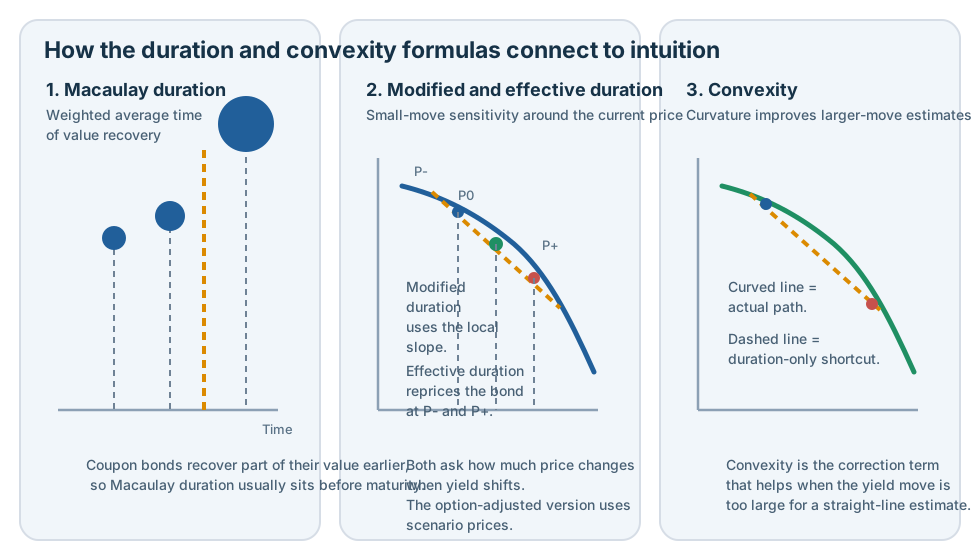
This SVG is useful here because the formulas are describing three different visual ideas: weighted timing, scenario-based price sensitivity, and curvature. Seeing those side by side makes the formulas easier to remember.
Understanding Duration
Duration is a measure of the sensitivity of a bond’s price to changes in interest rates. It reflects the weighted average time it takes for a bond’s cash flows to be paid. Duration is a critical tool for assessing interest rate risk, as it provides an estimate of how much a bond’s price will change in response to a 1% change in interest rates.
Macaulay Duration
Macaulay Duration is the weighted average time to receive the bond’s cash flows, where the weights are the present values of the cash flows. It is expressed in years and provides a time-based measure of a bond’s interest rate risk.
Formula:
\[ \text{Macaulay Duration} = \frac{\sum_{t=1}^{n} \left( \frac{t \cdot C_t}{(1 + y)^t} \right)}{\sum_{t=1}^{n} \left( \frac{C_t}{(1 + y)^t} \right)} \]Where:
- \( C_t \) = Cash flow at time \( t \)
- \( y \) = Yield to maturity
- \( n \) = Total number of periods
Sample Calculation:
Consider a bond with a face value of $1,000, a coupon rate of 5%, and a maturity of 3 years. The bond pays annual coupons, and the yield to maturity is 4%.
Calculate Cash Flows:
- Year 1: $50
- Year 2: $50
- Year 3: $1,050 (includes face value)
Calculate Present Values:
- Calculate Weighted Present Values:
- Sum of Weighted Present Values:
- Sum of Present Values:
- Calculate Macaulay Duration:
Modified Duration
Modified Duration adjusts the Macaulay Duration to account for changes in yield, providing a more accurate measure of a bond’s price sensitivity to interest rate changes.
Formula:
\[ \text{Modified Duration} = \frac{\text{Macaulay Duration}}{1 + \frac{y}{m}} \]Where:
- \( m \) = Number of compounding periods per year
Sample Calculation:
Using the Macaulay Duration from the previous example (2.86 years) and a yield of 4%:
\[ \text{Modified Duration} = \frac{2.86}{1 + \frac{0.04}{1}} = \frac{2.86}{1.04} = 2.75 \]Effective Duration
Effective Duration is used for bonds with embedded options, such as callable or putable bonds. It measures the sensitivity of a bond’s price to changes in interest rates, considering changes in cash flow patterns due to the options.
Formula:
\[ \text{Effective Duration} = \frac{P_{-} - P_{+}}{2 \times P_0 \times \Delta y} \]Where:
- \( P_{-} \) = Price if yield decreases
- \( P_{+} \) = Price if yield increases
- \( P_0 \) = Initial price
- \( \Delta y \) = Change in yield
Sample Calculation:
Suppose a bond’s price is $1000, and if the yield decreases by 0.5%, the price rises to $1020. If the yield increases by 0.5%, the price falls to $980.
\[ \text{Effective Duration} = \frac{1020 - 980}{2 \times 1000 \times 0.005} = \frac{40}{10} = 4 \]Understanding Convexity
Convexity measures the curvature in the relationship between bond prices and yields, providing a more accurate estimate of price changes for larger interest rate movements. It complements duration by accounting for the non-linear nature of price-yield changes.
Convexity Formula
Formula:
\[ \text{Convexity} = \frac{1}{P_0} \sum_{t=1}^{n} \left( \frac{C_t \cdot t \cdot (t + 1)}{(1 + y)^{t+2}} \right) \]Where:
- \( C_t \) = Cash flow at time \( t \)
- \( y \) = Yield to maturity
- \( n \) = Total number of periods
- \( P_0 \) = Initial price
Sample Calculation:
Using the bond from the Macaulay Duration example:
- Calculate Convexity:
- Calculate Each Term:
- Sum the Terms:
- Calculate Convexity:
Practical Applications
Understanding and calculating duration and convexity are crucial for several reasons:
- Interest Rate Risk Management: Duration and convexity help investors manage interest rate risk by providing insights into how bond prices will react to changes in interest rates.
- Portfolio Immunization: Investors can use duration matching to immunize portfolios against interest rate changes, ensuring that the portfolio’s duration aligns with the investment horizon.
- Pricing and Valuation: These metrics are essential for pricing and valuing bonds, especially those with embedded options, where cash flows may change with interest rate movements.
Real-World Examples
Consider a portfolio manager who needs to assess the interest rate risk of a bond portfolio. By calculating the duration and convexity of each bond, the manager can estimate the portfolio’s overall sensitivity to interest rate changes and make informed decisions about hedging or adjusting the portfolio’s composition.
Regulatory Considerations
In the context of U.S. securities regulations, understanding duration and convexity is vital for compliance with risk management standards set by regulatory bodies such as the Securities and Exchange Commission (SEC) and the Financial Industry Regulatory Authority (FINRA). These concepts are integral to assessing the risk profile of fixed income securities and ensuring that investment strategies align with regulatory guidelines.
Conclusion
Mastering the concepts of duration and convexity is essential for anyone involved in fixed income investing. By understanding these metrics, you can better manage interest rate risk, optimize investment strategies, and comply with regulatory requirements. Whether you’re preparing for the US Securities Exams or enhancing your professional practice, these tools are invaluable for navigating the complexities of bond markets.
Bonds and Fixed Income Securities Quiz: B.2 Duration and Convexity Formulas
By mastering the concepts and calculations of duration and convexity, you can enhance your understanding of bond markets and improve your ability to manage interest rate risk effectively. This knowledge is not only crucial for passing the US Securities Exams but also for making informed investment decisions in the world of fixed income securities.