Interest Rate Swap Mechanics
Understand how fixed-for-floating swaps are structured, priced, and settled.
10.1.1.1 Mechanics of Swaps
Interest rate swaps are a fundamental component of the derivatives market, playing a crucial role in managing interest rate risks and optimizing investment strategies. Understanding the mechanics of swaps is essential for finance professionals, investors, and students aiming to master fixed income securities. This section will delve into the intricacies of interest rate swaps, explaining their structure, types, and applications in the financial markets.
What is an Interest Rate Swap?
An Interest Rate Swap is a financial derivative contract between two parties who agree to exchange interest rate payments on a specified notional principal amount. The notional amount is not exchanged; it merely serves as the basis for calculating the interest payments. Swaps are primarily used to manage exposure to fluctuations in interest rates, allowing parties to achieve a desired interest rate profile.
Types of Interest Rate Swaps
Interest rate swaps come in various forms, each serving different purposes in financial management. The most common type is the Plain Vanilla Swap, but other variations exist to cater to specific needs.
Plain Vanilla Swap
A Plain Vanilla Swap involves the exchange of fixed interest payments for floating-rate payments, typically linked to a benchmark interest rate such as the London Interbank Offered Rate (LIBOR) or the Secured Overnight Financing Rate (SOFR). In this swap, one party pays a fixed rate, while the other pays a floating rate, allowing both parties to manage their interest rate exposure according to their preferences.
Example:
Consider two companies, Company A and Company B. Company A has a loan with a floating interest rate and expects interest rates to rise. To hedge against this risk, it enters into a swap agreement with Company B, which prefers the predictability of fixed payments. Through the swap, Company A pays a fixed rate to Company B, while Company B pays a floating rate to Company A. This arrangement allows Company A to stabilize its interest expenses, while Company B benefits from potential declines in interest rates.
Mechanics of Interest Rate Swaps
The mechanics of interest rate swaps involve several key components, including the notional principal, fixed and floating rates, and cash flow exchanges. Understanding these elements is crucial for navigating the complexities of swaps.
Notional Principal
The notional principal is the hypothetical amount upon which the swap payments are based. It is important to note that the notional principal is not exchanged between the parties; it merely serves as a reference for calculating interest payments.
Fixed and Floating Rates
In a plain vanilla swap, one party agrees to pay a fixed interest rate, while the other pays a floating rate. The fixed rate remains constant throughout the swap’s duration, providing predictability for the payer. The floating rate, on the other hand, fluctuates based on market conditions, typically linked to a benchmark rate like LIBOR or SOFR.
Cash Flow Exchanges
Interest rate swaps involve periodic cash flow exchanges between the parties. These exchanges are typically netted, meaning only the difference between the fixed and floating payments is exchanged. This netting reduces the cash flow exchanged, minimizing transaction costs and counterparty risk.
Diagram: Cash Flow Exchanges in a Plain Vanilla Swap
To better understand the cash flow exchanges in a plain vanilla swap, consider the following diagram:
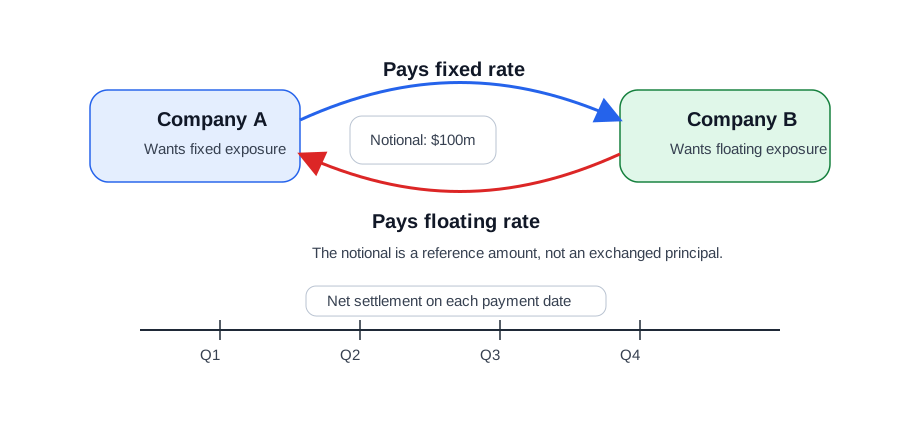
This timeline helps because swap mechanics are easier to understand as synchronized cash-flow exchanges than as a verbal definition alone.
In this diagram, Company A pays a fixed interest rate to Company B, while Company B pays a floating rate to Company A. The net cash flow is the difference between these payments, which is exchanged between the parties.
Applications of Interest Rate Swaps
Interest rate swaps are versatile instruments used for various purposes in financial markets. They are commonly employed for hedging, speculation, and arbitrage.
Hedging
Hedging is the primary use of interest rate swaps, allowing parties to manage their exposure to interest rate fluctuations. By converting floating-rate liabilities to fixed-rate payments, or vice versa, companies can stabilize their interest expenses and protect against adverse market movements.
Example:
A corporation with a floating-rate debt portfolio may enter into a swap to pay a fixed rate, thereby hedging against potential interest rate hikes. Conversely, a company with fixed-rate debt might use a swap to gain exposure to potentially lower floating rates.
Speculation
Speculators use interest rate swaps to profit from anticipated movements in interest rates. By taking positions in swaps, they can bet on the direction of interest rates, hoping to benefit from favorable changes in the market.
Example:
An investor anticipating a rise in interest rates might enter into a swap to receive floating payments, expecting the floating rate to increase and generate higher returns than the fixed rate paid.
Arbitrage
Arbitrageurs exploit price discrepancies in the swap market to earn risk-free profits. By identifying mispriced swaps, they can enter into offsetting positions to capture the price differential.
Example:
If a swap is mispriced relative to the underlying interest rate curve, an arbitrageur might simultaneously enter into a swap and a reverse swap to lock in a profit from the price discrepancy.
Real-World Applications and Regulatory Considerations
Interest rate swaps are widely used by corporations, financial institutions, and governments to manage interest rate risk. However, their use is subject to regulatory oversight to ensure transparency and mitigate systemic risk.
Regulatory Framework
In the United States, interest rate swaps are regulated by the Commodity Futures Trading Commission (CFTC) under the Dodd-Frank Wall Street Reform and Consumer Protection Act. The act mandates the clearing of standardized swaps through central counterparties (CCPs) to reduce counterparty risk and enhance market transparency.
Compliance Considerations
Market participants must adhere to regulatory requirements, including reporting swap transactions to swap data repositories (SDRs) and maintaining adequate risk management practices. Compliance with these regulations is essential for mitigating legal and operational risks.
Practical Example: Hedging with Interest Rate Swaps
Consider a utility company with a significant amount of floating-rate debt. Concerned about rising interest rates, the company enters into a plain vanilla swap to pay a fixed rate and receive a floating rate. This swap allows the company to lock in its interest expenses, protecting its cash flow from interest rate volatility.
Scenario:
- Floating Rate Debt: $100 million, LIBOR + 2%
- Fixed Rate in Swap: 5%
- Floating Rate in Swap: LIBOR
By entering into the swap, the utility company effectively converts its floating-rate debt into fixed-rate debt, stabilizing its interest payments and reducing financial uncertainty.
Conclusion
Interest rate swaps are powerful tools for managing interest rate risk and optimizing investment strategies. By understanding the mechanics of swaps, finance professionals can effectively navigate the complexities of the derivatives market and leverage these instruments to achieve their financial objectives.
For further exploration of interest rate swaps and their applications, consider reviewing resources from the International Swaps and Derivatives Association (ISDA) and Investopedia.
References
- Investopedia - Interest Rate Swap
- International Swaps and Derivatives Association (ISDA) - Swaps Overview
Bonds and Fixed Income Securities Quiz: Mechanics of Swaps
This comprehensive section on the mechanics of swaps provides a detailed understanding of interest rate swaps, their types, applications, and regulatory considerations. The included quiz reinforces key concepts, preparing readers for exams and practical applications in the securities industry.