Effective Convexity in Practice
Review how effective convexity is estimated and applied to bonds with embedded options.
16.4.2 Effective Convexity in Practice
In the realm of fixed income securities, understanding the nuances of bond pricing and risk management is crucial for investors, finance professionals, and students alike. One of the key concepts in this area is Effective Convexity, especially when dealing with bonds that have embedded options, such as callable and putable bonds. This section will guide you through the computation of Effective Convexity, compare it with the convexity of option-free bonds, and illustrate its significance in predicting price changes due to interest rate fluctuations.
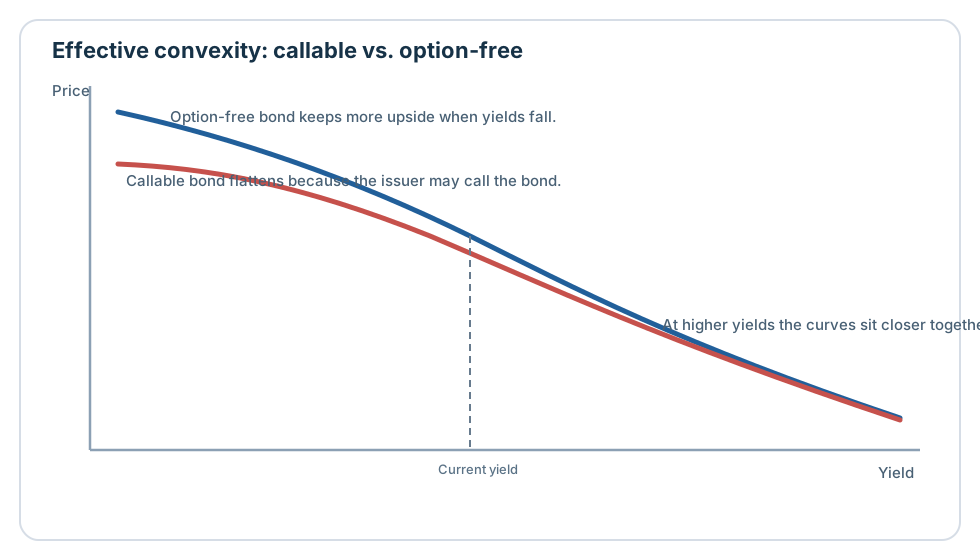
This SVG shows the core practical point of effective convexity: a callable bond does not keep the same upside curvature as an option-free bond when yields decline.
Understanding Effective Convexity
Effective Convexity is a measure of a bond’s sensitivity to interest rate changes, taking into account the impact of embedded options. Unlike traditional convexity, which assumes that cash flows remain unchanged, Effective Convexity recognizes that the cash flows of bonds with embedded options can vary depending on interest rate movements. This makes it a more accurate tool for assessing the price volatility of such bonds.
Computing Effective Convexity
To compute Effective Convexity, you need to consider the bond’s price changes in response to small changes in yield, while accounting for the potential exercise of embedded options. The formula for Effective Convexity is:
\[ \text{Effective Convexity} = \frac{(P_{-} - P_{+}) - 2P_0}{P_0 \times (\Delta y)^2} \]Where:
- \( P_{-} \) is the bond price if yields decrease.
- \( P_{+} \) is the bond price if yields increase.
- \( P_0 \) is the initial bond price.
- \( \Delta y \) is the change in yield.
This formula helps in quantifying how much a bond’s price will change for a given change in yield, considering the possibility of option exercise.
Comparing Effective Convexity: Callable vs. Option-Free Bonds
To illustrate the concept of Effective Convexity, let’s compare a callable bond with an option-free bond.
Example: Callable Bond vs. Option-Free Bond
Callable Bond:
- A callable bond gives the issuer the right to redeem the bond before its maturity date, usually when interest rates fall.
- This option affects the bond’s price sensitivity to interest rate changes because the bond may be called away, limiting the price appreciation.
Option-Free Bond:
- An option-free bond does not have embedded options, meaning its cash flows remain fixed regardless of interest rate movements.
- Its convexity is typically higher than that of a callable bond because there is no risk of early redemption.
Scenario Analysis:
- Consider a callable bond with a face value of $1,000, a coupon rate of 5%, and a maturity of 10 years. The bond is callable at par after 5 years.
- An option-free bond with the same face value, coupon rate, and maturity is used for comparison.
Interest Rate Change:
- If interest rates decrease by 1%, the callable bond’s price may not increase as much as the option-free bond because of the call option.
- Conversely, if interest rates increase by 1%, both bonds may decrease in price, but the callable bond’s decrease might be less pronounced due to the reduced likelihood of being called.
Effective Convexity Calculation:
- For the callable bond, calculate \( P_{-} \) and \( P_{+} \) considering the call option’s impact.
- For the option-free bond, compute \( P_{-} \) and \( P_{+} \) without any option adjustments.
Role of Convexity in Estimating Price Changes
Convexity is a crucial factor in estimating the price changes of bonds due to interest rate movements. It provides a second-order measure of interest rate risk, complementing duration, which is a first-order measure.
Importance of Convexity
Non-Linear Price-Yield Relationship:
- Convexity accounts for the non-linear relationship between bond prices and yields. As interest rates change, the price of a bond does not move in a straight line, and convexity captures this curvature.
Interest Rate Volatility:
- Bonds with higher convexity are less sensitive to interest rate volatility, providing a cushion against large price swings.
Portfolio Management:
- Understanding convexity helps in constructing bond portfolios that are better aligned with an investor’s risk tolerance and interest rate expectations.
Risk Mitigation:
- By considering convexity, investors can mitigate the risk of adverse price movements, especially in a volatile interest rate environment.
Practical Example: Effective Convexity in Action
Let’s consider a practical example to solidify your understanding of Effective Convexity.
Scenario:
- You are managing a bond portfolio that includes both callable and option-free bonds.
- You anticipate a potential shift in interest rates and want to assess the impact on your portfolio’s value.
Steps to Analyze Effective Convexity:
Identify Bonds with Embedded Options:
- Determine which bonds in your portfolio have call or put options.
Calculate Effective Convexity:
- For each bond with embedded options, compute the Effective Convexity using the formula provided.
Compare with Option-Free Bonds:
- Calculate the convexity of option-free bonds in your portfolio for comparison.
Assess Portfolio Impact:
- Analyze how changes in interest rates will affect the overall portfolio, considering the differential impact of Effective Convexity on callable versus option-free bonds.
Adjust Portfolio Strategy:
- Based on your analysis, decide whether to adjust your portfolio’s composition to optimize for expected interest rate movements.
Conclusion
Effective Convexity is a powerful tool for bond investors, providing a more accurate measure of price sensitivity for bonds with embedded options. By understanding and applying Effective Convexity, you can better manage interest rate risk and make informed investment decisions. Whether you are dealing with callable, putable, or option-free bonds, incorporating convexity analysis into your strategy will enhance your ability to navigate the complexities of the bond market.