Using Convexity to Improve Duration Estimates
See how convexity adjustments make duration-based price estimates more accurate across larger rate moves.
5.3.3 Using Convexity to Improve Duration Estimates
In the realm of fixed income securities, understanding the sensitivity of bond prices to interest rate changes is crucial for effective portfolio management. Duration, a well-known measure, provides an estimate of the percentage change in a bond’s price for a 1% change in interest rates. However, duration alone may not always provide a complete picture, especially for larger interest rate shifts. This is where convexity comes into play, offering a more refined measure that accounts for the curvature in the price-yield relationship of bonds.
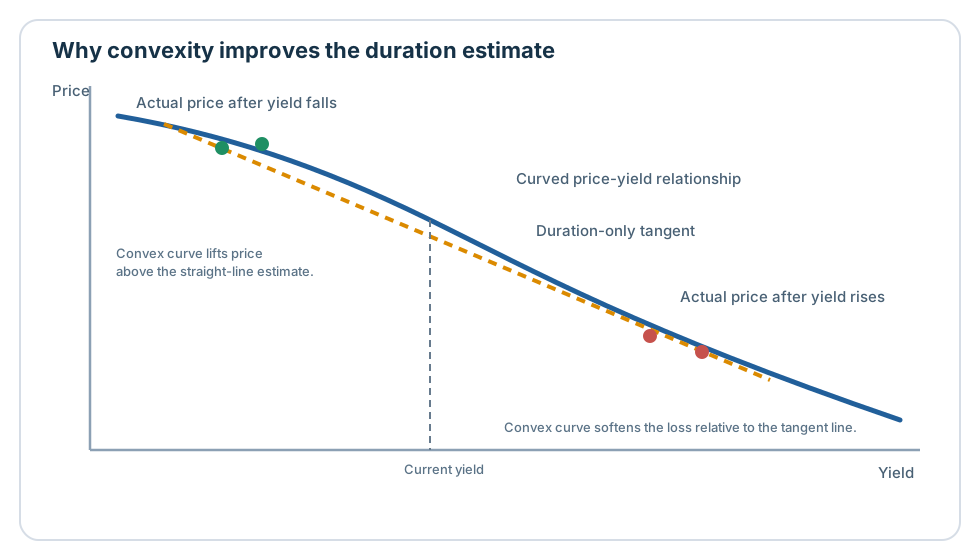
This SVG shows why duration alone is only a tangent approximation. The curved bond price-yield relationship is what convexity is correcting for when rate moves become larger.
Understanding Convexity
Convexity is a measure of the curvature in the relationship between bond prices and interest rates. While duration provides a linear approximation of how bond prices change with interest rate movements, convexity accounts for the fact that this relationship is actually curved. This curvature becomes more pronounced with larger changes in interest rates, making convexity a vital tool for estimating bond price changes more accurately.
The Price Approximation Formula
The price approximation formula that combines duration and convexity is expressed as follows:
\[ \Delta P \approx -D \times \Delta y + \frac{1}{2} \times C \times (\Delta y)^2 \]Where:
- \(\Delta P\) is the change in bond price.
- \(D\) is the duration of the bond.
- \(C\) is the convexity of the bond.
- \(\Delta y\) is the change in yield.
This formula illustrates that for small changes in interest rates, duration might suffice. However, for larger shifts, convexity becomes increasingly important, providing a second-order adjustment to the price change estimate.
Comparing Duration and Convexity Estimates
To demonstrate the impact of convexity, consider a bond with a duration of 5 years and a convexity of 40. Assume an interest rate increase of 2%.
Using Duration Alone
Using only duration, the estimated price change is:
\[ \Delta P \approx -5 \times 0.02 = -0.10 \text{ or } -10\% \]This estimate suggests a 10% decrease in bond price.
Using Duration and Convexity
Incorporating convexity, the estimate becomes:
\[ \Delta P \approx -5 \times 0.02 + \frac{1}{2} \times 40 \times (0.02)^2 = -0.10 + 0.008 = -0.092 \text{ or } -9.2\% \]The inclusion of convexity adjusts the price change to -9.2%, highlighting a less severe decrease than the duration-only estimate.
Scenarios Where Convexity is Crucial
Convexity is particularly important in scenarios involving:
Long-Duration Bonds: Bonds with longer durations exhibit greater sensitivity to interest rate changes, making convexity adjustments more significant.
Large Interest Rate Movements: In volatile markets, where interest rates can shift dramatically, convexity provides a more accurate reflection of potential price changes.
Portfolio Management: For portfolios with a mix of bonds, understanding convexity helps in managing interest rate risk more effectively, ensuring that potential price changes are accurately estimated.
Practical Examples and Scenarios
Example 1: Long-Duration Bond Portfolio
Consider a portfolio of long-duration bonds with an average duration of 10 years and convexity of 100. If interest rates rise by 1.5%, the duration-only estimate would suggest a 15% price decrease. However, incorporating convexity, the adjusted estimate would reflect a smaller decrease, providing a more realistic assessment of the portfolio’s sensitivity.
Example 2: High-Convexity Bonds
Bonds with high convexity, such as mortgage-backed securities, exhibit significant price sensitivity to interest rate changes. In such cases, relying solely on duration could lead to substantial mispricing, emphasizing the need for convexity in price change estimates.
Real-World Applications
In practice, financial analysts and portfolio managers use convexity to refine their interest rate risk assessments. By incorporating convexity into their models, they can better anticipate bond price movements, optimize portfolio allocations, and implement hedging strategies to mitigate potential losses.
Conclusion
In conclusion, while duration is a valuable tool for assessing bond price sensitivity, convexity offers a crucial enhancement, particularly for larger interest rate changes and portfolios with long-duration bonds. By understanding and applying the concepts of duration and convexity together, investors and finance professionals can achieve more accurate estimates of bond price changes, leading to better-informed investment decisions and more effective risk management strategies.
References
- CFA Institute. Using Convexity in Bond Price Estimation
Bonds and Fixed Income Securities Quiz: Using Convexity to Improve Duration Estimates
This comprehensive section on using convexity to improve duration estimates provides a deep dive into the importance of convexity in bond pricing, complete with practical examples and a quiz to reinforce learning.