Bond Investing Risks, Returns, and Income Tradeoffs
Evaluate the major risks of bond investing and understand how income, price change, and maturity profile shape fixed-income return.
Bonds are often described as conservative investments, but that label can be misleading if it is used without context. A short-term Treasury and a long-duration high-yield corporate bond are both bonds, yet they carry very different risk profiles. Bond return potential depends on income, price movement, and the investor’s ability to manage the specific risks built into the position.
Sources of Bond Return
Bond investors may earn return from:
- Coupon income: periodic interest payments
- Price appreciation: gains if the bond is sold above purchase price
- Pull to par: price convergence toward par as maturity approaches, assuming no default
That means bond return is not just “collecting interest.” Market price changes matter, especially when rates or credit conditions move.
Major Bond Risks
The principal risks include:
- Interest-rate risk: prices fall when market rates rise.
- Credit risk: the issuer may weaken or default.
- Inflation risk: future payments may buy less in real terms.
- Reinvestment risk: coupon payments may have to be reinvested at lower rates.
- Call risk: the issuer may redeem a callable bond when rates fall.
- Liquidity risk: the bond may be hard to sell at a favorable price.
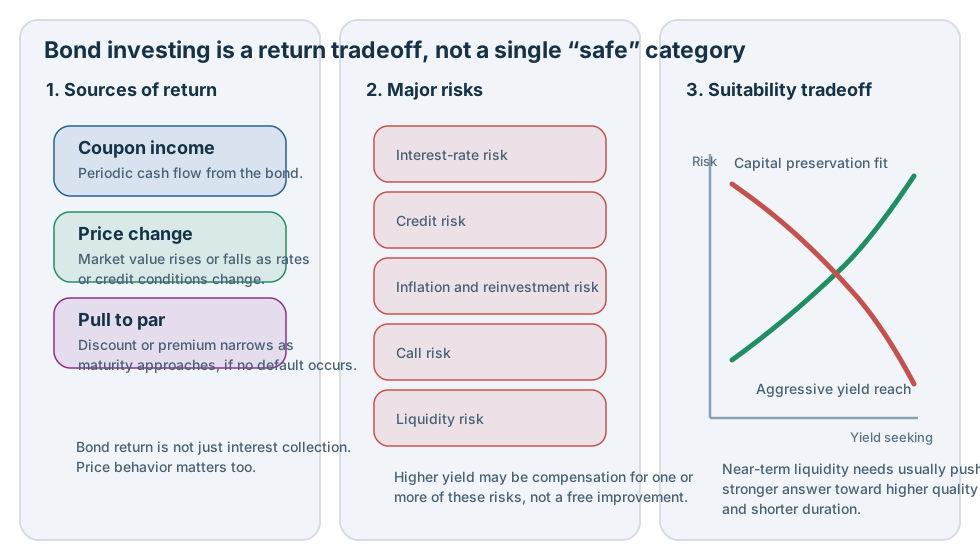
This SVG is more useful than a simple flowchart here because bond suitability is a tradeoff problem. Students need to see that return sources, risk sources, and client fit are connected rather than memorizing isolated labels.
Matching Bond Risk to the Investor
Suitability depends on why the customer owns the bond. A short-term liquidity need may call for less duration risk. A customer in a high tax bracket may evaluate municipal bonds differently from taxable bonds. A customer chasing yield by buying lower-quality long bonds may be taking more risk than the yield quote alone suggests.
This is the fixed-income version of a common exam principle: higher yield is usually compensation for higher risk, not free return.
Risk Management Approaches
Common approaches include:
- diversifying across issuers and maturities
- managing duration exposure
- laddering maturities
- monitoring credit quality and call features
These steps do not eliminate risk, but they help align the bond allocation with the customer’s goals and time horizon.
Key Takeaways
- Bond return comes from both income and price movement.
- Bond risk is multi-dimensional, not just a question of default.
- Higher yield usually reflects higher risk.
- Suitability depends on time horizon, liquidity need, tax status, and risk tolerance.
Sample Exam Question
A customer expects to need a large portion of invested funds within three years and says preservation of capital is more important than maximizing yield. Which bond allocation is most consistent with that profile?
A. Concentrated long-term high-yield bonds B. Long-duration callable bonds purchased at a premium C. A shorter-duration, higher-quality allocation aligned to the time horizon D. Zero-coupon speculative bonds maturing in fifteen years
Correct Answer: C
Explanation: A near-term liquidity need and emphasis on capital preservation generally point toward higher quality and shorter duration rather than aggressive yield-seeking.