Common Chart Patterns
Recognize major continuation and reversal formations without treating them as automatic predictions.
Chart patterns are recurring shapes formed by price movement. Traders study them because they can reflect crowd behavior during continuation, exhaustion, or reversal. The important point is not that every pattern works. The important point is that some structures create repeatable decision zones with definable risk.
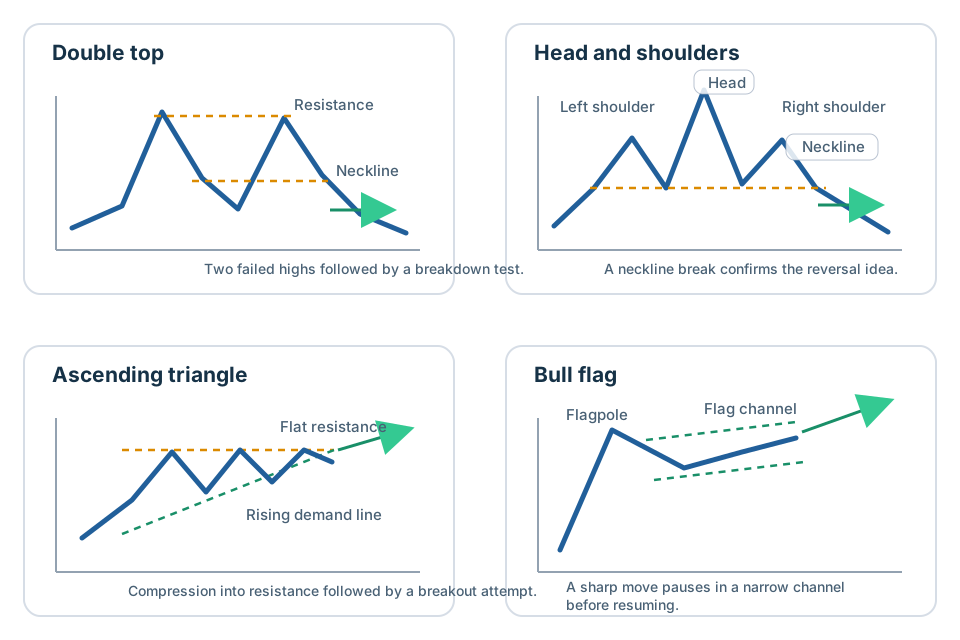
A pattern lesson works better with real geometry than a flowchart. This SVG shows the actual shapes traders are trying to recognize and confirm.
Continuation and Reversal
Patterns generally fall into two broad categories. Continuation patterns suggest that the existing trend may resume after consolidation. Reversal patterns suggest that the prior trend may be weakening and a new direction may emerge.
Common continuation patterns include flags, pennants, and some triangle formations. Common reversal patterns include head and shoulders, inverse head and shoulders, double tops, and double bottoms.
The classification is helpful, but it should not become rigid. Some patterns behave differently depending on the surrounding trend and the quality of the breakout.
Double Tops, Double Bottoms, and Head and Shoulders
A double top forms when price tests a similar high twice and fails to break through convincingly. A double bottom forms when price tests a similar low twice and holds. These formations can suggest that the prior move is losing strength.
The head and shoulders family is also widely watched. In its bearish version, the pattern reflects a weakening uptrend that fails to produce sustained new highs. In its inverse version, it reflects a weakening downtrend. The pattern becomes more meaningful when the neckline breaks and the break is confirmed.
Triangles, Flags, and Consolidation
Triangles and flags usually represent pauses in the existing move. A flag often forms after a sharp directional advance or decline, followed by a short consolidation. A triangle reflects narrowing price movement and compression between buyers and sellers.
What matters is not only the shape, but also the context:
- Did the pattern form after a clear trend?
- Is volume contracting during the pause?
- Does the breakout occur with stronger participation?
Without those supporting elements, the pattern may be weak or ambiguous.
Confirmation Matters More Than Recognition
Many inexperienced traders stop after identifying the pattern. That is incomplete. A recognized pattern is only a candidate setup. The actual trade decision should depend on confirmation, which can include:
- a decisive break beyond the boundary
- a strong close
- volume expansion
- successful retest behavior
This is why memorizing pattern names without a confirmation process usually produces poor results.
Typical Failure Modes
Patterns fail for several reasons. Markets can reverse suddenly on news. Breakouts can occur on weak volume and fade. Traders can also force a pattern where none really exists. In practice, the most dangerous pattern failure occurs when investors assume the chart shape guarantees a move and ignore invalidation.
A failed breakout or failed reversal pattern can itself become useful information because it shows that the anticipated side did not maintain control.
Practical Use
Investors should treat chart patterns as structured hypotheses. A pattern says, in effect, “If price clears this area with confirmation, one directional outcome becomes more likely.” It does not say, “The future is now certain.”
Used properly, patterns help define the trade location, stop placement, and expected follow-through. Used carelessly, they become excuses for overconfidence.
Key Takeaways
- Chart patterns are recurring structures that help organize probability.
- They can suggest continuation or reversal depending on context.
- Confirmation is more important than simply spotting the shape.
- A failed pattern can also provide useful information.
Sample Exam Question
A trader identifies what appears to be a bullish continuation flag after a strong advance. Which follow-up step is most consistent with disciplined technical analysis?
- A. Buy immediately because a flag never fails.
- B. Wait for a confirmed breakout with follow-through instead of relying on the pattern label alone.
- C. Ignore the trend that preceded the flag because only the consolidation matters.
- D. Assume the stock’s valuation no longer matters under any circumstances.
Correct Answer: B. A continuation flag can be useful, but the stronger technical process requires confirmation before treating the pattern as actionable.