Support and Resistance Levels
Identify price zones where buying or selling pressure has repeatedly changed direction and use them to frame risk.
Support and resistance are among the most basic concepts in technical analysis. Support is a zone where demand has previously been strong enough to slow or stop a decline. Resistance is a zone where supply has previously been strong enough to slow or stop an advance. These are not magic lines. They are areas where the market has shown memory.
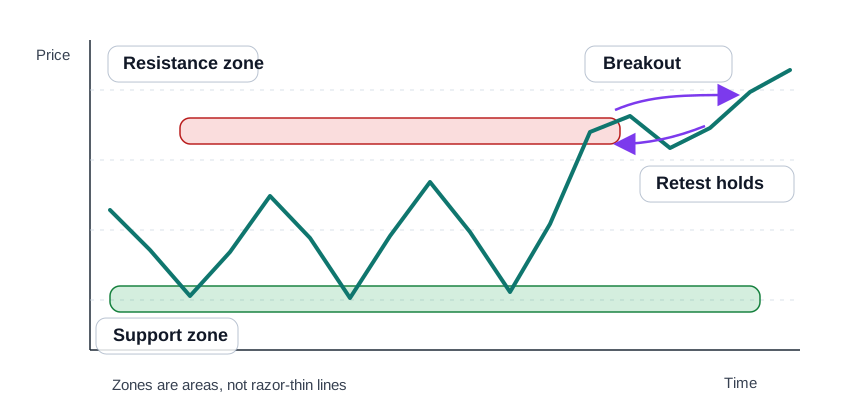
This diagram shows the practical sequence traders care about most: visible zones, a break beyond resistance, and the retest that helps confirm whether the new level is being accepted.
Why These Levels Matter
Support and resistance help investors convert a vague market opinion into a defined plan. If a trader expects buyers to defend a support area, the trader can define a nearby invalidation point in case that defense fails. If a trader expects resistance to break, the trader can require confirmation before acting.
These levels matter because price often attracts orders around prior turning points. Investors remember previous losses or gains. Algorithms react to visible zones. Institutions may add or reduce positions around well-observed levels. All of that can create repeat behavior.
Identifying Useful Levels
The strongest levels are usually those that:
- have been tested multiple times
- are visible across more than one time frame
- coincide with a prior breakout or breakdown zone
- align with heavy-volume turning points
A level drawn only from one isolated touch is less reliable than a level that has repeatedly affected price behavior. The investor should think in terms of zones, not razor-thin lines, because price often trades slightly above or below a level before reversing.
Support, Resistance, and Role Reversal
One common technical principle is role reversal. A resistance level that breaks decisively can later act as support. A support level that fails can later act as resistance. This happens because traders who missed the first move or were trapped on the wrong side often respond when price revisits the area.
Role reversal is useful because it helps an investor test whether the breakout or breakdown is being accepted by the market. A successful retest often carries more weight than the initial break alone.
How Traders Use the Levels
Support and resistance are often used to define:
- possible entry zones
- stop placement
- target areas
- whether a breakout has follow-through
For example, a trader buying near support is not simply hoping for a bounce. The trader is usually asking whether the reward to a resistance area justifies the risk below support. Without that risk-reward framing, the level is only a visual observation.
False Breaks and Trap Moves
Not every break is real. Price may move above resistance briefly and then reverse sharply. It may dip below support only to recover by the close. These false breaks often trap traders who act too early.
That is why confirmation matters. Confirmation can come from:
- a strong close beyond the level
- increased volume
- a successful retest
- continued follow-through in the next bars
The goal is not to avoid all false signals. The goal is to avoid treating every touch or break as decisive.
Key Takeaways
- Support and resistance are zones where market behavior has changed before.
- They help investors define entries, exits, and risk.
- Stronger levels usually have multiple tests and broader visibility.
- False breaks are common, so confirmation is important.
Sample Exam Question
A stock has failed three times near the same price zone and is now approaching that level again on light volume. Which technical conclusion is most reasonable?
- A. The prior ceiling guarantees a breakdown.
- B. The level is irrelevant because only indicators matter.
- C. The price zone still functions as likely resistance until a stronger breakout is confirmed.
- D. The stock should be purchased automatically before it reaches the level.
Correct Answer: C. Repeated failure near the same zone suggests active resistance. Until price clears the zone with confirmation, it remains a meaningful obstacle.