Reading Candlestick Charts
Interpret candlestick bodies and shadows to assess short-term buying and selling pressure more precisely.
Candlestick charts display the same basic OHLC information as bar charts, but they do it in a way that makes short-term buying and selling pressure easier to recognize visually. Because the body and shadows stand out clearly, candlesticks are widely used by traders who want to judge whether the market is accepting or rejecting a given price zone.
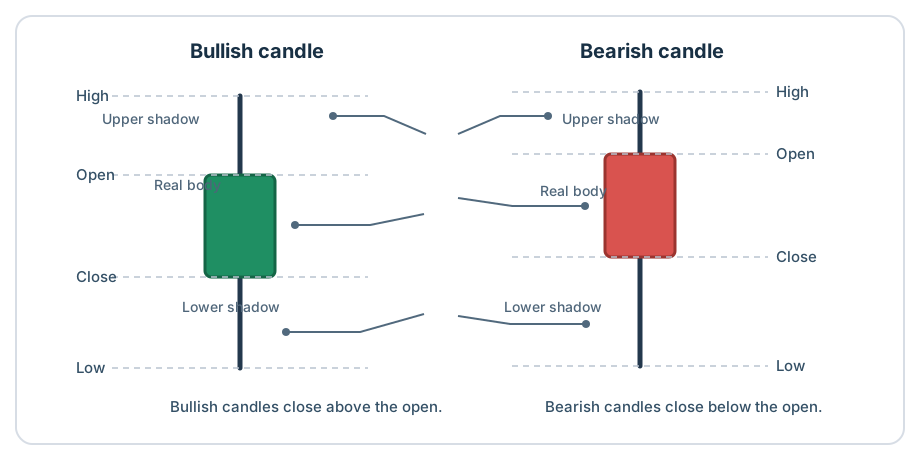
This SVG makes the candle anatomy explicit: the body marks the open-close relationship, while the shadows capture the intraperiod extremes.
The Parts of a Candlestick
A candlestick contains:
- a body, which marks the distance between the open and the close
- an upper shadow, which shows the distance from the higher of open or close to the period high
- a lower shadow, which shows the distance from the lower of open or close to the period low
If the close is above the open, the candle is commonly displayed as bullish. If the close is below the open, it is displayed as bearish. The visual contrast allows traders to interpret the balance of pressure quickly.
What Candlesticks Communicate
Candlestick charts are especially useful for recognizing shifts in control. A long bullish body suggests sustained buying pressure. A long bearish body suggests sustained selling pressure. Long shadows can signal rejection, failed extension, or indecision depending on the surrounding context.
The key is that candlesticks are not important because they look dramatic. They are important because they summarize a struggle between buyers and sellers in a compact and readable way.
Interpreting Candles in Context
Single candles can be useful, but they become much more meaningful when combined with trend, level, and volume context. A hammer-like candle near a major support area after a long decline can carry a different implication than the same candle in the middle of a choppy range.
Investors should ask:
- Where did the candle appear?
- Did it occur after an extended move?
- Was the candle confirmed by the next period?
- Did volume support the move?
Without those questions, candlestick reading becomes pattern memorization without judgment.
Common Candlestick Themes
Some common themes include:
- rejection of lower prices after a sharp selloff
- rejection of higher prices after an extended rally
- indecision when the body is small relative to the shadows
- continuation when strong bodies align with the prevailing trend
These themes matter more than the memorization of dozens of named candle patterns. The best use of candlesticks is to understand pressure and rejection, not to hunt endlessly for labels.
Strengths and Limits
Candlestick charts are excellent for short-term interpretation, but they do not eliminate false signals. A reversal-looking candle can fail immediately. A large bullish candle can appear at the end of a move rather than the beginning of one.
That is why professional use of candlesticks usually involves confirmation. Traders often wait for the next session to validate the message rather than assuming that one candle has settled the issue.
A Practical Workflow
An effective workflow is:
- Start with the larger trend.
- Mark nearby support and resistance.
- Observe whether a candlestick suggests acceptance or rejection.
- Require confirmation from the next move or from another tool.
- Define the trade risk before acting.
This process keeps the candle in the right role. It informs the trade plan, but it does not replace it.
Key Takeaways
- Candlestick charts present OHLC data in a visually readable format.
- The body and shadows help investors judge pressure and rejection.
- Candles are most meaningful at important levels and within clear trend context.
- Confirmation matters more than memorizing candle names.
Sample Exam Question
After a long decline, a stock drops below support intraday but then rallies sharply and closes near the session high with a long lower shadow. What is the most reasonable technical interpretation?
- A. Buyers may have rejected lower prices, but confirmation is still needed.
- B. The stock must begin a new uptrend immediately.
- C. The candle proves the company is fundamentally undervalued.
- D. The candle has no technical value because only line charts matter.
Correct Answer: A. A long lower shadow after a decline can suggest rejection of lower prices, but a disciplined technical approach still looks for confirmation from subsequent action.