Using MACD
Use MACD to compare trend momentum, signal-line behavior, and possible shifts in directional strength.
MACD, short for Moving Average Convergence Divergence, is a momentum indicator built from moving averages. Traders use it to judge whether momentum is strengthening or weakening and whether short-term price behavior is diverging from the broader trend. Because it blends trend-following and momentum concepts, it is one of the most common indicators in stock trading.
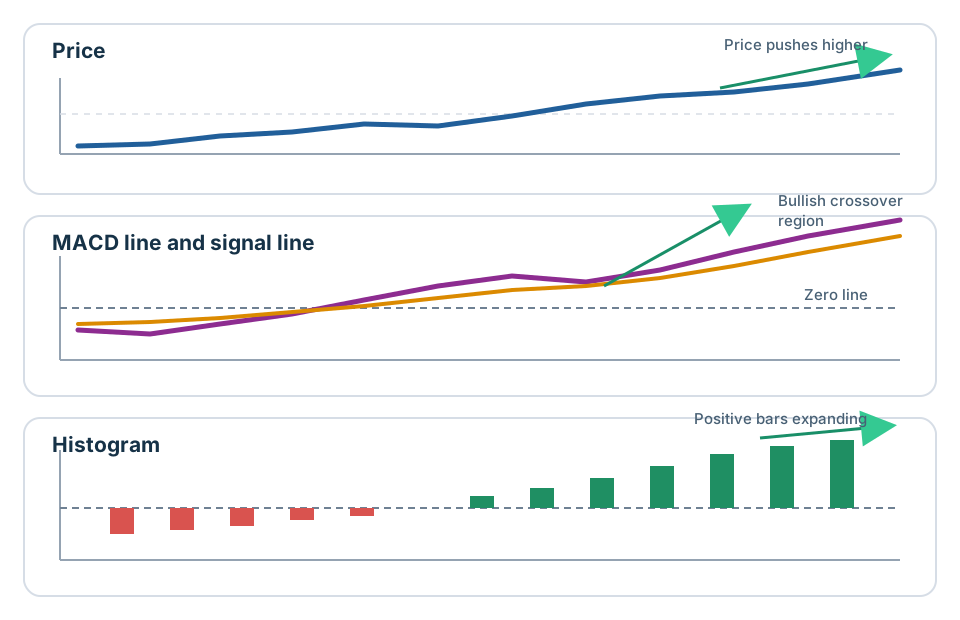
MACD is not a process flow. The indicator becomes much clearer when price, the crossover, and the histogram are shown as aligned panels.
What MACD Tries to Show
MACD compares a faster moving average with a slower one. When the faster measure begins to pull away upward, MACD tends to strengthen. When momentum weakens and the faster measure loses ground, MACD tends to soften.
The indicator is typically discussed through three components:
- the MACD line
- the signal line
- the histogram, which reflects the gap between the two
Together, these help traders judge whether momentum is accelerating, decelerating, or crossing into a different phase.
Signal-Line Crossovers
One of the most widely used MACD concepts is the crossover between the MACD line and the signal line. A bullish crossover can suggest improving upside momentum. A bearish crossover can suggest fading strength or increasing downside pressure.
The problem is that crossovers can be late or noisy, especially when the stock is range-bound. That is why a crossover should not be treated as sufficient by itself. It becomes more useful when it aligns with price structure, support and resistance, or a fresh breakout.
The Histogram and Momentum Quality
The histogram provides a quick visual read of momentum spread. A growing histogram can indicate increasing separation between the MACD line and the signal line, which often corresponds with strengthening momentum. A shrinking histogram can indicate that the prior directional push is losing force.
This is valuable because it helps traders detect change earlier than the eye sometimes can from raw price alone. Still, the histogram is a supporting clue, not a stand-alone decision engine.
Trend Confirmation and Divergence
MACD can also be used to confirm or question the prevailing trend. If price is rising and MACD is strengthening, the trend has technical support from momentum. If price is still rising but MACD is flattening or deteriorating, the move may be losing quality.
This divergence can matter, but it does not automatically produce a reversal. Markets can continue higher even as momentum cools. The more prudent response is to tighten attention, not to assume immediate failure.
Best Use Cases
MACD is particularly useful when:
- a stock is transitioning from consolidation into trend
- the trader wants to measure momentum quality, not just direction
- crossovers align with key price levels
- the investor wants a second check on whether a breakout has real follow-through
It is less useful when the market is choppy and directionless because rapid back-and-forth movement can generate repeated false signals.
Common Mistakes
A common mistake is treating every bullish crossover as a buy and every bearish crossover as a sell. Another mistake is ignoring the broader time frame. A weak daily MACD signal may matter much less if the weekly structure remains strongly supportive.
The best use of MACD is comparative. It helps the trader ask whether momentum is improving or fading relative to what price is attempting to do.
Key Takeaways
- MACD compares faster and slower trend behavior to evaluate momentum.
- Crossovers can be useful, but they are not self-sufficient signals.
- The histogram helps show whether momentum spread is widening or narrowing.
- MACD works best when combined with price structure and context.
Sample Exam Question
A stock breaks above resistance, but MACD remains weak and the histogram does not expand. What is the strongest technical interpretation?
- A. The breakout is guaranteed to fail.
- B. MACD weakness is irrelevant after any breakout.
- C. The breakout may lack momentum confirmation, so follow-through should be watched carefully.
- D. The stock must now be valued with a lower P/E ratio.
Correct Answer: C. A breakout without momentum confirmation may still work, but MACD weakness suggests the investor should be cautious about assuming strong follow-through automatically.