Using Moving Averages
Understand how moving averages smooth price data and how traders use them to judge trend direction and possible support or resistance.
Moving averages smooth price data so that the underlying trend is easier to interpret. Instead of focusing on every short-term fluctuation, the investor looks at an average of recent prices and asks whether that average is rising, falling, flattening, or being crossed by current price. This makes moving averages one of the most widely used trend tools in stock analysis.
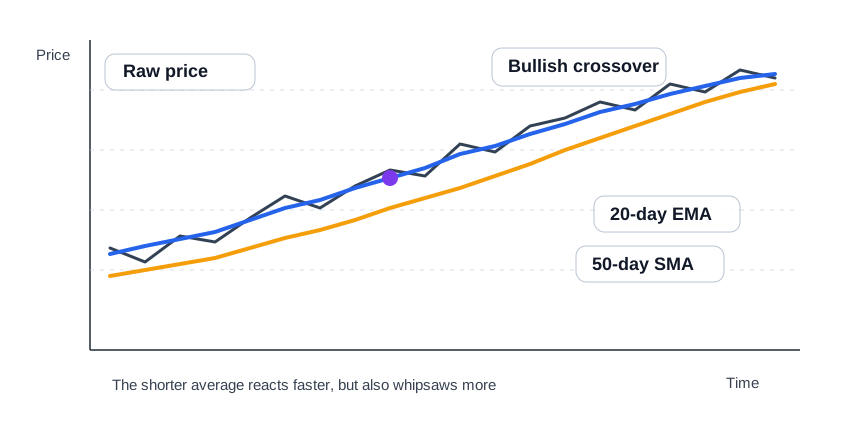
This overlay is useful because moving averages are not abstract formulas on the page. They are trend references layered directly onto price behavior.
Why Moving Averages Matter
The central benefit of a moving average is noise reduction. A stock may move erratically day to day while still following a clear intermediate trend. The moving average helps investors see that broader direction more cleanly.
Moving averages are often used to assess:
- overall trend direction
- whether momentum is improving or weakening
- whether pullbacks remain orderly
- whether price is extended from its recent average
They do not predict the future. They summarize recent behavior in a form that can support more consistent decisions.
Simple and Exponential Moving Averages
Two common versions are the simple moving average and the exponential moving average. A simple moving average gives equal weight to all prices in the lookback period. An exponential moving average gives more weight to recent prices and therefore reacts faster.
Neither is automatically better. A faster average is more responsive but can generate more noise. A slower average is smoother but may react late. The right choice depends on the investor’s time horizon and purpose.
Using the Average in Trend Analysis
Investors often interpret price relative to the moving average. Price above a rising average can suggest an intact uptrend. Price below a falling average can suggest an intact downtrend. A flat average can indicate a lack of clear direction.
The slope of the average matters. A stock briefly trading above a declining average does not necessarily mean the trend has improved. Likewise, a short dip below a rising average does not automatically end an uptrend.
Crossovers and Their Limits
Some traders use moving-average crossovers, such as a shorter average crossing above or below a longer one, to signal possible trend change. This can be helpful in strong trends, but it is not foolproof. Crossovers can whipsaw repeatedly in range-bound markets.
The better use of a crossover is as one piece of evidence. If price structure, volume, and broader market context all point in the same direction, the crossover has more value. If it appears alone in a choppy chart, it may be weak.
Moving Averages as Dynamic Levels
Moving averages can also act as dynamic support or resistance. In an uptrend, repeated pullbacks toward a rising average may show that buyers are defending the trend. In a downtrend, rallies toward a falling average may fail and reinforce seller control.
This is useful because it helps an investor distinguish a normal retracement from a potential structural failure. Still, the average is not a guaranteed defense line. It is a reference area that becomes meaningful only when price repeatedly respects it.
Common Mistakes
One mistake is using too many moving averages at once. When the chart is filled with overlapping lines, decision quality usually declines. Another mistake is treating every touch or crossover as a trade. A moving average should clarify the chart, not replace judgment.
A final mistake is forgetting that moving averages are lagging tools. They summarize what has already happened. That is not a weakness when they are used properly, but it becomes a problem when investors expect them to forecast turning points precisely.
Key Takeaways
- Moving averages smooth price data and clarify trend.
- Simple averages are slower; exponential averages react faster.
- The slope of the average matters as much as price location.
- Crossovers and touches require context and confirmation.
Sample Exam Question
An investor sees that a stock remains above a rising 50-day moving average despite several short pullbacks. Which interpretation is most reasonable?
- A. The intermediate trend may still be intact because price continues to respect a rising average.
- B. The moving average proves the stock is undervalued fundamentally.
- C. The investor should ignore risk because the average cannot fail.
- D. The stock must be sold immediately because any pullback is bearish.
Correct Answer: A. Repeated respect for a rising moving average can support the view that the intermediate trend remains intact, although it does not guarantee continuation.