Using the Relative Strength Index
Interpret RSI as a momentum gauge and understand why overbought or oversold readings require context.
The Relative Strength Index, or RSI, is a momentum oscillator that helps traders judge whether price gains or losses have become unusually stretched over a chosen period. It is popular because it condenses recent momentum into a simple range and gives traders a language for discussing acceleration, exhaustion, and divergence.
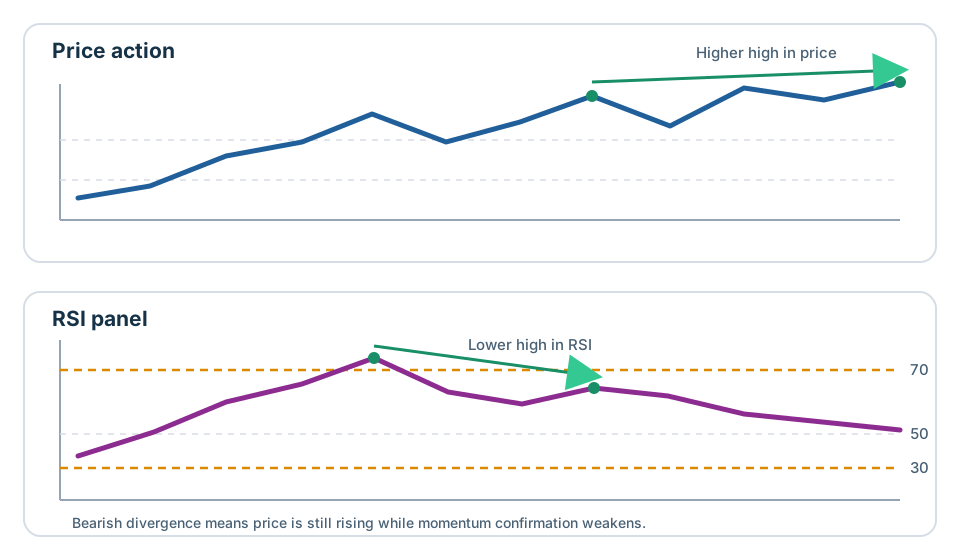
RSI is easiest to understand when price and momentum are stacked on the same time axis. This SVG highlights a bearish-divergence setup directly.
What RSI Measures
RSI does not measure value. It measures the speed and consistency of recent price movement. When RSI is high, upward momentum has been strong relative to downward movement. When RSI is low, downward momentum has dominated.
Traders often use approximate thresholds such as:
- above 70 for overbought conditions
- below 30 for oversold conditions
These are conventions, not guarantees. A stock can remain overbought for long periods in a strong uptrend or oversold for long periods in a sharp decline.
Why RSI Is Useful
RSI can help investors judge whether momentum is strengthening, weakening, or diverging from price. It is especially useful when combined with support and resistance, trend structure, and other evidence.
For example, if price is testing a long-term resistance zone while RSI is failing to confirm the new high, the investor may interpret that as a warning that upside momentum is less convincing than the headline price move suggests.
Overbought and Oversold Are Not Automatic Signals
One of the most common mistakes in technical analysis is assuming that overbought means “sell now” and oversold means “buy now.” In reality, those readings often describe trend strength as much as potential exhaustion.
In a strong uptrend, RSI may stay elevated because buying pressure is persistent. In a strong downtrend, RSI may stay depressed because sellers remain in control. The indicator becomes more useful when the investor asks how the RSI reading fits the broader chart rather than treating the threshold itself as sufficient.
Divergence and Momentum Loss
Divergence occurs when price and RSI stop moving in the same way. A stock may print a higher high while RSI fails to do so. That can suggest weakening momentum. A stock may also print a lower low while RSI stops deteriorating, which can suggest that downside pressure is losing force.
Divergence is informative, but it still needs confirmation. Markets can continue trending despite divergence. The stronger process is to use divergence as an alert, then wait for structure or price behavior to confirm the shift.
RSI and Trend Context
RSI should be interpreted differently depending on trend conditions. In a strong uptrend, repeated support in the middle range may be more important than occasional overbought readings. In a strong downtrend, repeated failure of RSI to recover may reinforce bearish conditions.
That means the investor should not use identical RSI rules in every market. Indicators become more valuable when their readings are matched to the broader structure.
Common Mistakes
Common errors include:
- treating RSI as a standalone trade trigger
- forcing divergence where none exists
- ignoring the trend behind the reading
- using RSI without any price-level context
RSI is best thought of as a supporting indicator. It adds information about momentum, but price structure remains primary.
Key Takeaways
- RSI is a momentum oscillator, not a valuation tool.
- Overbought and oversold readings require trend context.
- Divergence can be useful, but it still needs confirmation.
- RSI works best as a supplement to price analysis, not a replacement for it.
Sample Exam Question
A stock in a strong uptrend has an RSI above 70 for several sessions while price continues making higher highs and respecting support. What is the most reasonable conclusion?
- A. The stock must reverse immediately because RSI is above 70.
- B. RSI is irrelevant in all trending markets.
- C. The stock is automatically overvalued on a fundamental basis.
- D. RSI shows strong momentum, but the investor still needs price-based confirmation before assuming a reversal.
Correct Answer: D. An elevated RSI can reflect strong trend momentum. It does not, by itself, prove that a reversal has started.